Revolution without reckoning
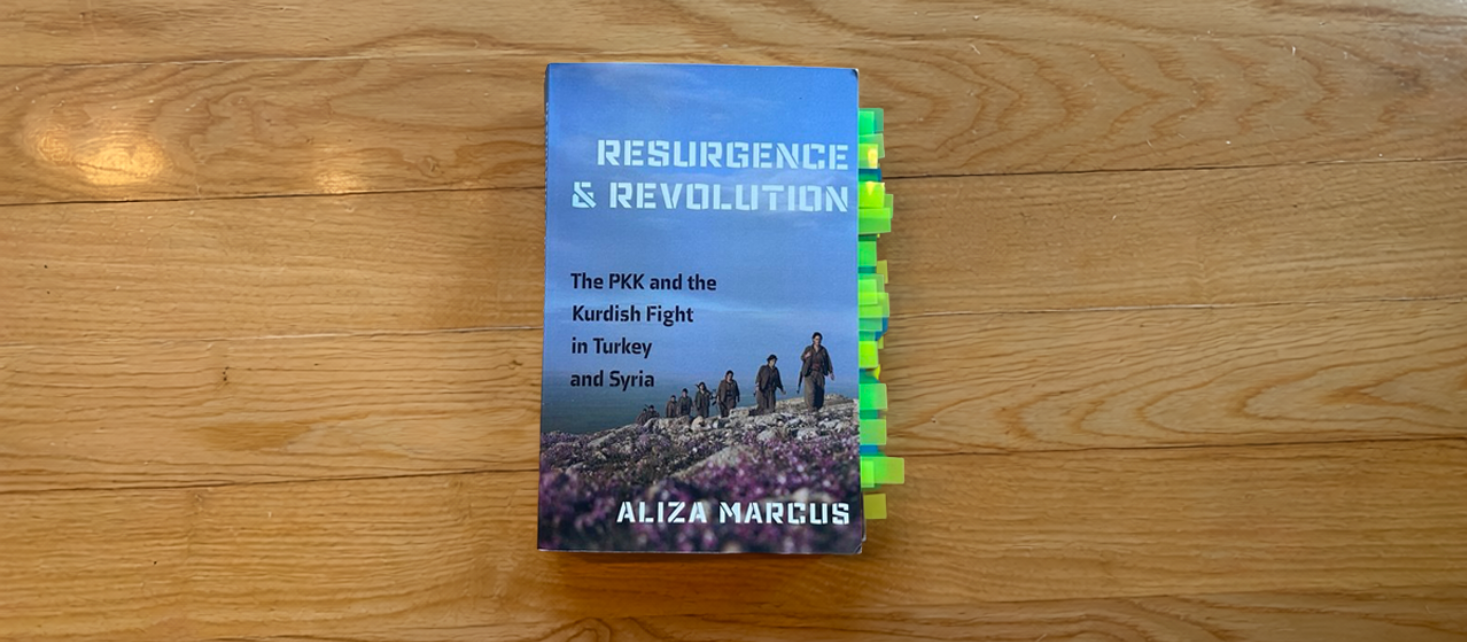
A review of Aliza Marcus’s book ‘Resurgence & Revolution: The PKK and the Kurdish Fight in Turkey and Syria’
Aliza Marcus’s latest book offers a useful timeline of events and insightful interviews with PKK figures; but the darker stains remain woven into a compelling liberation narrative instead of being allowed to disrupt it – leaving empty some much-needed space between romanticisation and demonisation.
Anyone looking for critical literature offering an inside view of the Kurdistan Workers’ Party (PKK), particularly its Syrian affiliate, encounters a familiar problem. Even accounts not written by former People’s Protection Units (YPG) fighters themselves and presented as scholarly studies tend to carry distinctly activist undertones.
A recurring strand of this literature draws on a Western-centric and often racist view of the “Arab” Middle East as a region of backwardness and violence. Against this backdrop, the PKK’s socialist project, and especially the Rojava project of its Syrian affiliate, the Democratic Union Party (PYD), is cast as a beacon of emancipatory progress and democracy. This framing is as romanticised as it is widespread in Western intellectual circles and has repeatedly surfaced in Western media debates on Syria since the early years of the war, suggesting an almost natural convergence between Western political preferences and Kurdish political aspirations.
Published by New York University Press in April 2026, Aliza Marcus’s Resurgence & Revolution: The PKK and the Kurdish Fight in Turkey and Syria promises a combination of reportage and scholarship, drawing much of its authority from extensive testimony and insider knowledge. Across six chronologically structured chapters, Marcus traces the movement from Abdullah Öcalan’s imprisonment in the late 1990s and the ensuing PKK crisis through its regional reorganisation and expansion in Syria, and Assad’s fall in late 2024. Syria remains a key focus throughout, particularly the rise of the PYD and the painstaking construction of the self-proclaimed revolutionary project in Rojava. Its dissolution in the spring of 2026 came too late to make it into the book.
Reportage or scholarship?
Despite offering revealing insights into the PKK’s inner struggles, justifications and perspectives, the book invites a rather less generous assessment when measured against the scholarly standards implied by its publication with New York University Press and its billing as a combination of reportage and scholarship. This is not to say that lengthy methodological discussions are a prerequisite for scholarly research. Salwa Ismail’s 'The Rule of Violence', among others, demonstrates as much. Marcus’s book, however, outlines neither an analytical problem nor a research gap or thesis, while the book’s broad guiding question on the PKK’s trajectory is primarily historical and descriptive. Indeed, Marcus explicitly frames Resurgence & Revolution as a continuation of her 2007 book Blood and Belief, which ended with Öcalan’s capture in 1999.
What may initially appear a pedantic objection takes on greater significance as the book progresses. Sources that might challenge Marcus’ account are rarely brought into the discussion, while tensions within the material she herself presents are rarely pursued to their analytical conclusions. This matters because Marcus hardly shies away from the PKK’s authoritarian record. She documents Öcalan’s extraordinary authority extending even beyond the walls of Imrali prison, as well as assassinations of former members, the repression of rival Kurdish groups and the PKK’s dominance over the supposedly grassroots democratic project in Syria.
In other words, the book provides the ingredients for a critical inquiry without carrying it through. What is missing is a systematic analytical progression towards conclusions that confront the PKK’s ideological claims with the political order it built in Syria and try to make sense of the contradictions between the two. Instead, Marcus mainly recounts events, lending them immediacy through insider testimony, mostly from PKK members and US diplomats. As the analytical problem the book seeks to address remains unclear, there is no framework through which the evidence might be worked into an argument. That feels like a missed opportunity given the scarcity of structured and balanced examinations of the PKK and its affiliates.
The PKK and the Assad regime
One of many analytical questions the book could have examined concerns the PKK’s relationship with the Assad regime. Tracing the PKK’s history in Syria from the 1980s onwards, Marcus naturally addresses its peculiar relationship with the regime, which sheltered Öcalan until 1998. She notes that Syria “had been a stable and relatively secure place for the PKK to recruit, train, and meet foreign observers”, yet does not reckon with the full extent of this bargain and its implications for a movement claiming to fight Kurdish oppression. The contradiction deserves attention as Syrian Kurdish grievances were effectively subordinated to the PKK’s war in Turkey: the PKK commodated with the Baathist regime despite the latter’s long record of denying Kurdish political and cultural rights.
Marcus recounts the regime’s repression in Qamishli in 2004 and gives Kurdish activists space to describe their experiences in Assad’s dungeons. But although she acknowledges criticism of the PKK’s cooperation with the Assads and points to the regime’s instrumental interest in its presence, she does little to examine the deeper contradiction inherent in this relationship. The PKK occupied a privileged position as the only Kurdish political movement granted such room to operate by the Assad regime, and joining its ranks could even exempt young Syrian Kurds from conscription into the Syrian military. Assad’s support went considerably further than passive tolerance: Syria’s mukhabarat reportedly supplied Öcalan and the PKK with money, weapons and false documents, using the organisation as leverage against Turkey and Iraq.
An analytical approach would have to set this relationship against the brutal record of anti-Kurdish politics rooted in the uncompromising Arabism of Syrian Baathism. Baathist ideologue Muhammad Talab Hilal, later Deputy Prime Minister and Minister of Agriculture and Agrarian Reform under Hafiz al-Assad, was a principal architect of policies restricting Kurdish citizenship, education and cultural autonomy, and of the repressive Arab Belt project that dispossessed tens of thousands of Kurdish families. For the arrangement with Damascus to function, the PKK maintained a conspicuous silence on this history of repression and refrained from directing its struggle against those responsible for it. More than that, operating under Assad’s protection required some accommodation with the regime’s own denialist premises, which Öcalan himself reproduced quite explicitly in 1996 when he claimed that most Kurds in Syria were refugees from Turkey.
Given the PYD’s tactical accommodation with the Assad regime from 2011 onwards and the consequences this had for the Syrian conflict, the PKK’s selective blindness would have deserved closer examination, both for its strategic roots and for what it reveals about the PKK’s self-conception. The issue surfaces again in Marcus’s own account of the 2021 dispute between the Qandil leadership and Mazloum Abdi’s camp over reconciliation with Damascus. PKK co-founder Cemil Bayik defended rapprochement by invoking the movement’s historically close relationship with the Assad family – precisely the paradoxical continuity that Marcus leaves unexplored but which would have been valuable to examine both historically and for what it may tell us about current and future debates on transitional justice.
Democracy of the vanguards
That Qandil remained in charge of major decisions concerning the PKK and its regional affiliates matters because it casts doubt on the movement’s claim to have transcended nationalism. It also raises fundamental questions about the emancipatory promise of grassroots ‘democratic communalism’. Marcus repeatedly describes Öcalan as the centre of the organisation, the sovereign gatekeeper of virtually every major decision, yet she does not confront the glaring contradiction between the near-totalitarian personality cult behind this structure and the movement’s democratic self-description and its claim to “represent every aspect of Kurdish society.”
Marcus repeatedly documents the group’s relentless pursuit of hegemony, which shaped Rojava’s supposedly self-governing project. Local cadres remained embedded in a hierarchy answerable to Qandil, and meaningful power rested with the Qandil elite and the cadres it sent to Syria. She describes the Autonomous Administration of North and East Syria (AANES) as a system of “interlocking and sometimes parallel representative bodies”, but avoids a scholarly discussion of how this system actually worked. She does not engage with the distinctly Leninist logic behind this arrangement, in which the party vanguard claims to know the path towards emancipation and enforces it; or how such rule was experienced from below, particularly in Arab-majority areas. This may partly reflect Marcus’s choice of interviewees: those who ruled under years of PKK hegemony are given space, while those who were ruled are absent.
What these substantial discrepancies between universalist claims and political practice meant for subjects of this rule is left open. The fact that attempts to reshape society according to Öcalan’s ideological model of democratic confederalism at times took on distinctly colonial features, with Arab communities portrayed and treated as socially backward, should have prompted a much deeper discussion of the movement’s pluralist and participatory claims. The AANES struggled to impose reforms such as the prohibition of polygamy in the face of heavy resistance from locals and, in several cases, responded to such resistance from Arab tribes with coercion and repression, but also co-option.
Human rights organisations have levelled serious allegations against the PKK/PYD-led project of abuses including ethnic cleansing in rural Hasakah and the disappearance of political opponents, journalists and activists. There have also been allegations of torture and mass killings in detention facilities holding former ISIS members, as well as war crimes during the many battles against ISIS’s caliphate, culminating in the 2019 battle of Baghouz – ISIS’ last stand - where observers were barred and the site, along with an unknown number of bodies, was quickly bulldozed.
The near-total silence on the repressive side of governing Arab-majority areas deprives the book of depth, as confronting these tensions would have been central to testing the movement’s claimed rejection of ethnic nationalism. Looking at the evidence of more than a decade of PKK/PYD rule in Syria, it is difficult to escape the conclusion that Kurds were primus inter pares: communal democracy was always framed by Kurdish predominance, with the PKK forcibly monopolising what Kurdish identity itself meant.
Feminist agency under revolutionary discipline
This privileging extends to women’s liberation, one of the ideological trademarks of the PKK, which Marcus describes as “half the fight” of the group’s struggle for emancipation. But whose liberation is actually at stake deserves closer scrutiny. Marcus does not discuss that the political representation and institutional empowerment offered by the PKK and its Syrian project came as part of an ideological package that also entailed PKK hegemony, which many Syrians, including Arab women living under AANES rule, rejected. In other words, female emancipation was tied to buying into a model of strict hierarchy and personality cult centered on a man. And it was a model under which, according to allegations by human rights organisations, sexual violence against women accused of supporting rival factions was no isolated occurrence.
Marcus’s narrative focusses on the difficult path through which Kurdish women entered the movement’s fighting ranks and later gained political representation in Rojava. Seen largely through the perspective of selected PKK women themselves, the story is framed primarily as one of success. Marcus records some of the constraints of cadre life, yet rarely turns them into the harder question of what kind of emancipation a militant organisation produces when its bargain of freedom comes with strings attached: critical research points to widened female agency, but also to recruitment practices that capitalised on the aspirations of young women, including minors, seeking to escape restrictive social environments, alongside strict regulation of sexuality and constant party oversight.
The PKK’s achievement in giving women even a conditional degree of political visibility within a deeply patriarchal environment deserve recognition, no question. A critical account should nevertheless have examined how women’s empowerment became a powerful propaganda tool for securing Western sympathy, while simultaneously existing within authoritarian practices and ultimately broadening the pool of people willing and able to carry a gun for the cause.
Lessons for the future?
Marcus does draw broader lessons from the story she has told, but primarily in strategic and organisational terms. She criticises the return to war against the Turkish state in 2015 and Öcalan’s rigid leadership that was unable to adapt to changing circumstances or develop an effective civilian political leadership. The deeper questions of the movement’s emancipatory integrity and ideological coherence, and the conditions necessary for meaningful reform, however, remain unaddressed, even as Marcus rightfully portrays the PKK as an unavoidable actor in any future settlement, and in the achievement of wider regional stability.
What remains is a hero’s journey, with its darker stains woven into the story rather than allowed to rupture the liberation narrative. Reconstructing the history and self-image of a militant movement on the basis of statements from its participants can undoubtedly yield insights, even in the absence of systematic academic analysis. Yet knowledge can accumulate without yielding much analytical clarity. An honest discussion of the achievements and failures of the revolutionary experiment could have provided the basis for concrete lessons about what a movement claiming authority in Kurdish emancipation should preserve, abandon or fundamentally rethink. It might also have given more substance to the case that neither demonisation nor glorification of the movement serves the legitimate Kurdish struggle for self-determination.