Follow the money
Hassan Akkad’s arrest and Syria’s new red lines
The arrest of prominent British-Syrian journalist Hassan Akkad sparked public outcry and a broader debate about the limits of free speech in Syria’s emerging political order. His subsequent release shows that public pressure still carries weight in today’s Syria. But the broader debate over the limits of free expression - that Western democracies, too, continue to wrestle with - has only just begun.
In the months after the fall of the Assad regime, Syria’s transitional government promised a country where free speech was protected, going as far as to enshrine it in Article 13 of its constitutional declaration. Syria’s Ministry of Information actively celebrated the country’s increase in the Reporters Sans Frontiers World Press Freedom rankings and produced glossy videos about the ease of access to Syria compared with the Assad era. Despite some alarming signs, like foreign journalists being prohibited from accessing the coast during the massacres of March 2025, it was widely agreed that the country was witnessing an unprecedented opening for free expression. A common concern among journalists, media figures and ordinary Syrians alike, however, was that nobody knew where red lines, if any, actually lay.
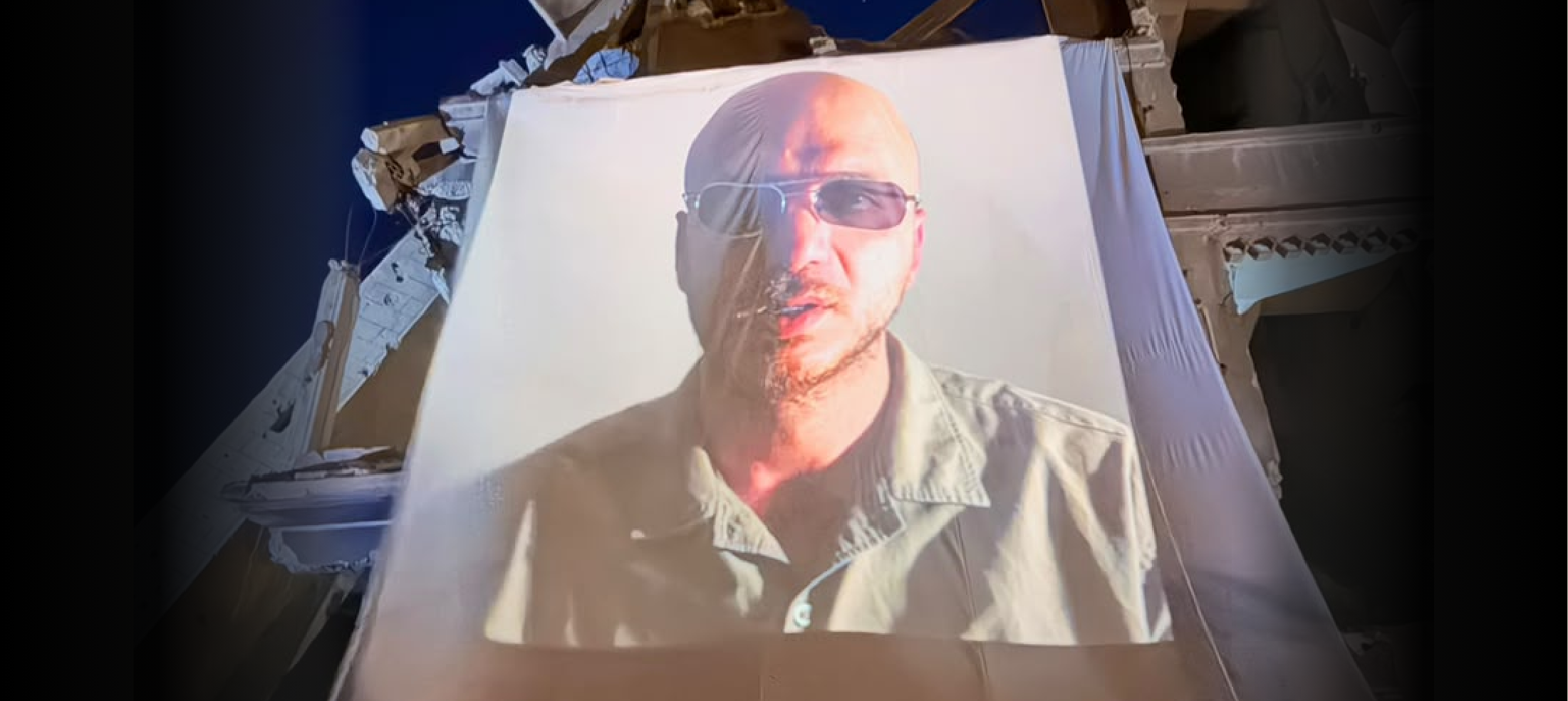
The arrest of British-Syrian journalist Hassan Akkad on 17 May seems to have provided an answer, at least partly. Widely hailed as “Syria’s Tourist Minister” in the early days of his fame, Akkad’s tongue-in-cheek videos about the idiosyncrasies of Syrian society won the hearts of netizens. Over time, his content veered more towards overt activism. On February 24, he posted a video as part of his new series, “English With Hassan”, using war profiteers including Mohammed Hamsho to explain the phrase ‘transactional justice’.
“You would think those three men should be in prison, but they’re not. They paid some money, let go of some assets, and now they can work in Syria as free men,” he says as he wraps up. He was referring to Hamsho's January 2026 financial settlement with the Syrian transitional government, under which assets reportedly worth around $800 million were confiscated in exchange for reconciliation.
Mohammed Hamsho was known as the ‘rubble king’ for his theft of iron from houses in destroyed neighbourhoods. He was also known to be a key economic frontman for Maher al-Assad’s Fourth Division. To-date, he remains sanctioned by the US government and European Union.
“Give us the money that you owe”
With the launch of his campaign “Give us the money that you owe,” Akkad satirically called out public figures who were yet to pay donations they had pledged in flashy fundraising campaigns held a few months prior. Among those he targeted was Minister of Social Affairs and Labour Hind Kabawat and Fouad Sayed Issa, advisor to the Minister of Sports and Youth Affairs. Both welcomed the initiative and paid their dues.
According to Akkad’s team, a turning point came when the campaign began explicitly targeting Mohammed Hamsho and companies affiliated with him. Hamsho’s status was settled with the new government as part of a ‘Voluntary Disclosure Program’ under a newly established Committee to Combat Illicit Gains. Though economic settlements are common during political transitions - Colombia provides one example - the line blurs when it appears that those implicated in crimes have the opportunity to buy their way out of accountability. The illicit gains committee has been criticised for a lack of transparency. The speed with which Hamsho’s case was resolved, together with the limited public information about the assets seized from him, invited the ire of Syrians who view Hamsho as an economic pillar that held up the Assad regime.
From the very start, Akkad called out Ahmed and Amr Hamsho, Mohammed Hamsho’s sons, for not fulfilling their pledge of $1 million towards reconstruction after their family settled their status and began to polish their image in public. Akkad’s last video before announcing that he had been summoned by the Cybercrime Department and the Ministry of Information celebrated the withdrawal of the Chinese technology company Oppo from a deal with Itsal, a Syrian company owned by the Hamsho family. Earlier, he had also urged consumers to boycott the German soft drinks company Sinalco, whose Syrian operations are owned by the Hamshos.
The apparent connection between Akkad’s criticism and the circumstances of his arrest raises the question of how far criticism is tolerated in the new Syria when it is directed at the powerful, not primarily political figures, but those who are financially well-off. Notably, Akkad’s videos had previously criticised Syrian President Ahmed al-Sharaa himself for not paying the money he had publicly pledged, without facing repercussions. His case therefore illustrates the complex interplay between wealth, political influence and perceived loyalties in post-Assad Syria. It brings into the spotlight the opacity of the government’s reconstruction and reconciliation policies at a time when public demands for transparency are growing.
To-date, the only known complaint against Akkad was filed by Mousa al-Omar, a businessman and media figure close to Syria’s leadership. Yet, from the very day the complaint was filed, Akkad had noticed Hamsho’s legal team monitoring his online activity. When he was summoned to the Cybercrime Department in Damascus, his legal team says they found themselves facing a lawyer representing United Industrial Investment Company - another name for Sinalco’s Syrian operator. This followed informal settlement offers from individuals who identified themselves as representatives for Mohammed Hamsho; all of which Akkad declined, refusing to meet anyone affiliated with the businessman. On 23 June his team publicly clarified that they were seeking $2.1 million with regard to pledges made by Hamsho’s sons and Yafour Hotel and Resort, another company linked to the family.
Akkad had also posted a clip of a meeting he had with the CEO of Sinalco, raising fears about a potential cancellation of their contract with Hamsho too. According to the team, the complaint against Akkad was processed ‘unusually fast’ - in just a couple of days when the process usually takes about two weeks. In an interview with SyriaTV, Akkad’s lawyer, Amjad Sawan, explained that there were two complaints before the Cybercrime Department, although he declined to identify the complainants. According to Akkad’s team, both originated from companies affiliated with Hamsho: United Industrial Investment and Retjenu Joint Stock Company.
Following his release, Akkad said that the Public Prosecution Office had explicitly refused to issue him with a criminal record certificate, telling him simply: “Because you are Hassan Akkad.” If accurate, this suggests that he was treated as an exceptional case because of his public profile and his willingness to challenge authority. Syria in Transition has also learned that social media influencers, who constitute an important part of Syria’s media landscape, were instructed not to comment publicly on Akkad’s case.
Syria’s 2022 cybercrime law
In a video statement, Hossam Khattab, the Attorney General of Syria, explained that Akkad was accused by al-Omar of defamation and online slander. He was detained under a 2012 Assad-era cybercrime law that had long been used to crush dissent and curtail freedom of speech online. The law was expanded in 2022, extending its scope to comments on social media pages and introducing harsher penalties for offenses such as defamation or undermining the state’s prestige.
It is striking how - in a country scarred by years of war, with a litany of outstanding transitional justice cases - the authorities chose to expedite and prioritise Hassan Al-Akkad’s case over others. During the same week, Syria witnessed riots and mob violence driven by frustration over the paucity of transitional justice. Although it is arguable that such cases fall under the jurisdiction of the transitional justice courts, the hate speech and online sectarian campaigns that accompanied those events would, under strict interpretations of the cybercrime law, also constitute violations. Yet little action was taken.
Furthermore, as explained by the Attorney General himself, the case was referred to the Cybercrime Unit, which is tasked with tackling allegations that require technical or forensic analysis. Akkad’s videos did not fit this description. According to a lawyer consulted by Syria in Transition, the case echoes a familiar practice under the Assad regime: restricting dissent while insisting that freedom of expression exists, provided it remains “within the limits of the law.”
Akkad’s case is not isolated. Other activists have also faced defamation complaints. On 2 June Yasser Abbas and Ibrahim Sheikh al-Shabab, who had campaigned for the repeal of Decree 66 - another Assad-era law - were arrested following a complaint by the Governor of Damascus alleging defamation. Increasingly, legal provisions once used by the Assad regime are being deployed by the new authorities against activists and critics.
In December 2025 American journalist Bilal Abdul Kareem, who spent most of the civil war in Idlib, was arrested after his coverage grew increasingly critical of President Ahmed al-Sharaa engaging with the United States. To-date, there are no updates on his arrest and he has effectively been forcibly disappeared. The contrast between the international outcry over Akkad’s arrest and the relative silence surrounding Kareem’s detention is revealing. It reflects the emergence of a new, internationally connected Syrian public sphere that was largely absent under the Salvation Government in Idlib. Many journalists, activists and civil society figures now maintain close links with international media, governments and advocacy organisations, making quiet arrests significantly more costly than they once were.
Re-examination of the law
Following Akkad’s release, the Ministry of Justice announced the formation of committees to review a number of laws, including the cybercrime legislation, affirming its commitment to protecting public freedoms. The announcement was widely welcomed as a sign that the government was responsive to legitimate public concerns. By the end of June the Ministry had also announced procedural changes to the handling of cybercrime complaints, providing that most cases would be dealt with directly by the courts rather than the police, and that search warrants and pre-trial detention would be used more sparingly.
This, however, does not negate a broader pattern of expanding state control over freedom of expression and association. Following demonstrations in Damascus calling for the rule of law in early June, the Ministry of Interior introduced new regulations requiring prior authorisation for public protests: a committee of at least three organisers now needs to file an application for a permit that can take up to five days to be processed, which effectively bans spontaneous demonstrations.
In October 2025 the Ministry of Social Affairs and Labour instructed NGOs to continue complying with Law 93, another Assad-era statute requiring government approval before receiving foreign funding. Most recently, the Ministry of Information announced six new restrictions on publishing and the media, including prohibitions on material deemed harmful to public morals or to the national economy. Taken together, these laws, regulations and administrative directives point towards an increasingly restrictive environment for journalists, activists and civil society organisations alike. At the same time, Akkad’s release demonstrates that public pressure still carries weight in today’s Syria. The emerging political order appears neither willing nor, perhaps, fully able, to suppress dissent in the manner of the Assad regime. Whether that reflects political choice or political constraint remains an open question.
The question of where legitimate free expression ends and unlawful incitement begins is, of course, not unique to Syria. Western democracies, too, continue to wrestle with prosecutions over offensive online speech. But in Syria, where debates over accountability, truth-seeking and reconciliation remain central to the transition, defining those boundaries will have especially profound consequences. That debate needs to deepen. For it to do so, a critical mass of Syrians must be willing to rally behind freedom of expression as a foundational principle, regardless of whose speech is at stake.