Searching for Um Kamel
26. May 2026
Why Syrians still adore a fictional woman played by a man
In one of Syria’s television networks, executives gather to celebrate the channel’s first anniversary. The hall is full: sharp suits, broad smiles, congratulatory speeches about professionalism and the station’s growing influence. Thirty men sit around the table — without a single female journalist among them — discussing, celebrating and planning the future.
Happening too often
At another event, this time in a different Syrian province and under the banner of “The Role of Women in Society”, rows of women sit quietly while a man lectures them on their roles, occasionally slipping from discussion into outright instruction.
To begin with, I no longer feel obliged to reiterate that criticising the appalling representation of women in Syria’s new state does not amount to hostility towards men, nor does it reduce men to some caricature of “the enemy”. Yet men undoubtedly bear part of the responsibility. Do they not notice the absence of their female colleagues? Do they not realise that silence itself is a form of tacit complicity?
Listening to a man droning on, I tried to analyse the scene, to place it in its broader context, to understand its causes and imagine possible ways out of what Syrians colloquially call dawlat al-zelim — “the state of men”. But the headache defeated me. The pounding in my skull followed me into sleep, where I found myself swaying helplessly between two crushing walls.
Then a woman appeared before me, wearing the traditional Damascene headscarf. She seemed determined to pull me free from that suffocating space.
I stared at her in disbelief. Could it really be her? The woman my grandmother adored, whose appearances on black-and-white television she awaited impatiently, and about whom she spoke endlessly?
It was indeed Um Kamel.
The woman Syrian men are comfortable with
Um Kamel was a fictional character created and performed by the Syrian actor Anwar al-Baba in the 1940s. She first appeared on radio during a cholera outbreak in Syria, when public health campaigns urgently needed to reach mothers in particular. Al-Baba invented Um Kamel as a witty, quick-thinking Syrian woman through whom health messages could be delivered gently and effectively to female audiences. She would later become one of the most beloved figures in Syrian theatre and television.
But the timing of her emergence matters as much as the character herself. Um Kamel appeared during a delicate moment in Syrian history: the period immediately following independence from French colonial rule, when the modern Syrian state was still taking shape amid an intensely conservative and socially complex environment — not unlike the Syria of today.
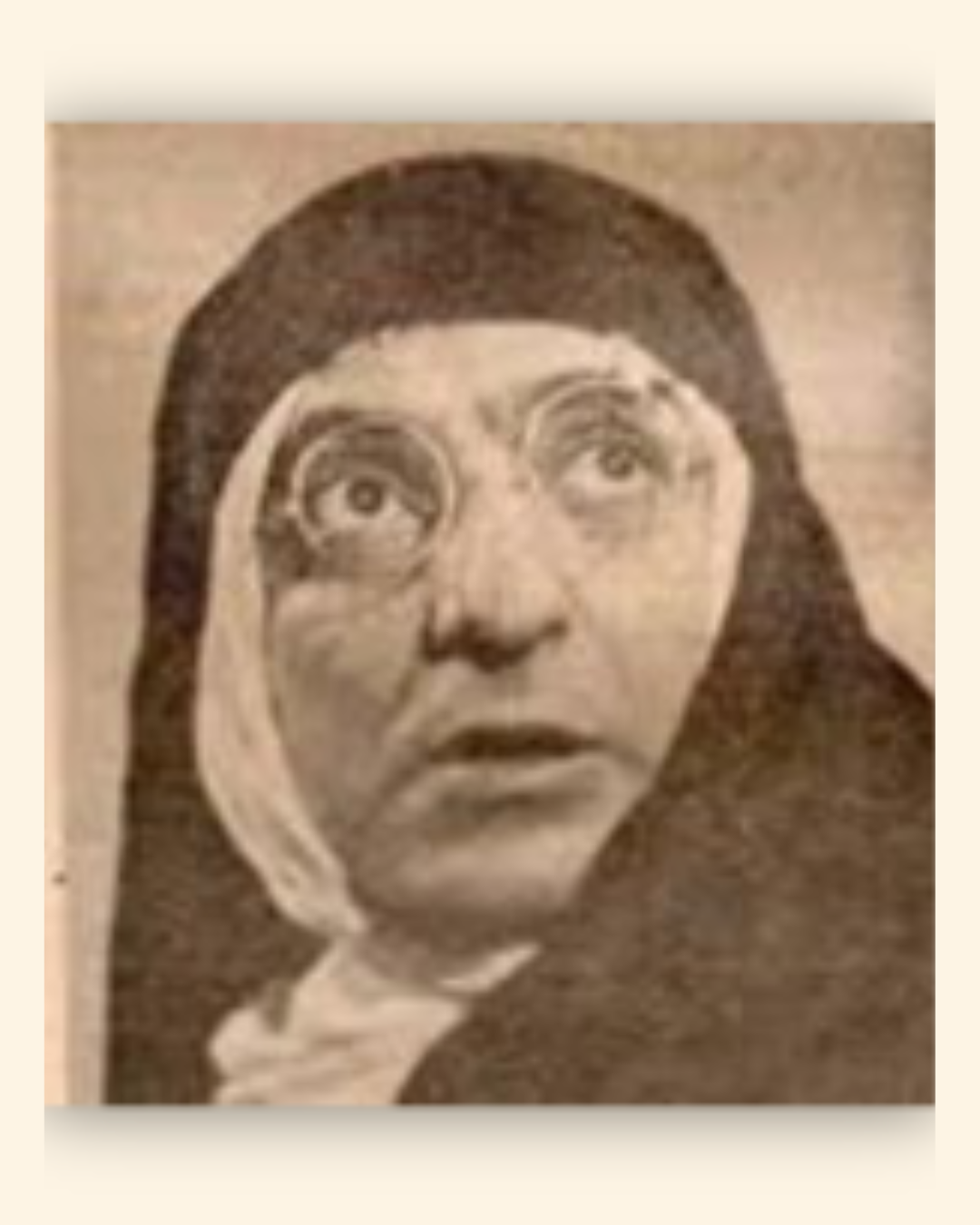
Back then, too, women’s presence in public life was far from self-evident. Women did not step onto theatre stages, address audiences directly or occupy media spaces as they do now. Yet there existed, at least partially, an awareness that women had to be included somehow — and that reaching them required a different language, different tools and a degree of respect for their social realities.
Mansplaining
As I slept, a booming voice seemed to echo above my head — the unmistakable tone of male instruction. The term itself may be relatively modern, first popularised in 2008 after the American writer Rebecca Solnit published her essay Men Explain Things to Me, describing the infuriating phenomenon of men confidently explaining subjects to women who often know far more about them — sometimes even books the women themselves had written.
Mansplaning, of course, is much older.
It has existed for as long as Um Kamel herself: on our television screens, our stages, in our schools, institutions and councils. The man perpetually casts himself as the guardian of all knowledge, lecturing women on how they should speak, what they should wear, which professions suit them and, eventually, on the very nature of womanhood itself.
This culture has produced another distortion, one no less exhausting than mansplaining itself: what I can only describe as performative toughness.
Any conversation with a man becomes, for many women, a battlefield in which they must constantly prove themselves. Women are pushed towards sharper language, exaggerated displays of expertise or endless competitions over competence simply to avoid being patronised or dismissed. The bitter irony, of course, is that women are then criticised for this very sharpness — as though it were some innate flaw rather than a survival mechanism developed inside a world reluctant to acknowledge them as equals.
At that moment, Um Kamel pulled me violently to the ground. My head struck a sharp stone and I awoke in panic.
I looked around, sought refuge from Satan and muttered: thank God, it was only a dream.
But no — this is no dream. It is a nightmare Syrian women have endured since the 1940s until today: a reality in which every claim of progress seems inversely proportional to women’s actual presence.
Fictional women
Perhaps next year Syria’s media establishment will celebrate the “renewal of Syrian intangible heritage” by resurrecting Um Kamel once more. Perhaps newspapers will overflow with praise for this supposedly brilliant revival of national memory. Perhaps they will even erect a statue of Um Kamel in Damascus’s Hijaz Square to honour this cherished national icon.
A society, after all, managed to love Um Kamel, laugh with her and memorise her catchphrases. Yet that same society still struggles to accept a real woman sitting at the same table as a full partner — discussing, planning and helping to build Syria’s future.
That is why Um Kamel feels more present today than ever before. Because she was fictional — a woman written and performed by a man. A woman designed precisely as men wished women to be.
And perhaps that is why she appeared in my dream at all: to ask us one devastating question: How can a fictional woman from the 1940s remain more visible than real Syrian women — women who carried the revolution on their shoulders, fought for it, and continue to resist even now?