Classroom revolution?
What education reveals about the state of Syria’s transition
For decades, Syria’s schools quietly sustained authoritarian rule, instilling habits of obedience. Today, as the country embarks on a political transition, the classroom offers a revealing test: not just of what has changed in the curriculum, but of how much of the old system still endures beneath the surface.
When we think about why dictatorships endure, we usually look to prisons, intelligence agencies, patronage networks or foreign backers. Much less attention is paid to a quieter, but equally powerful institution: the school.
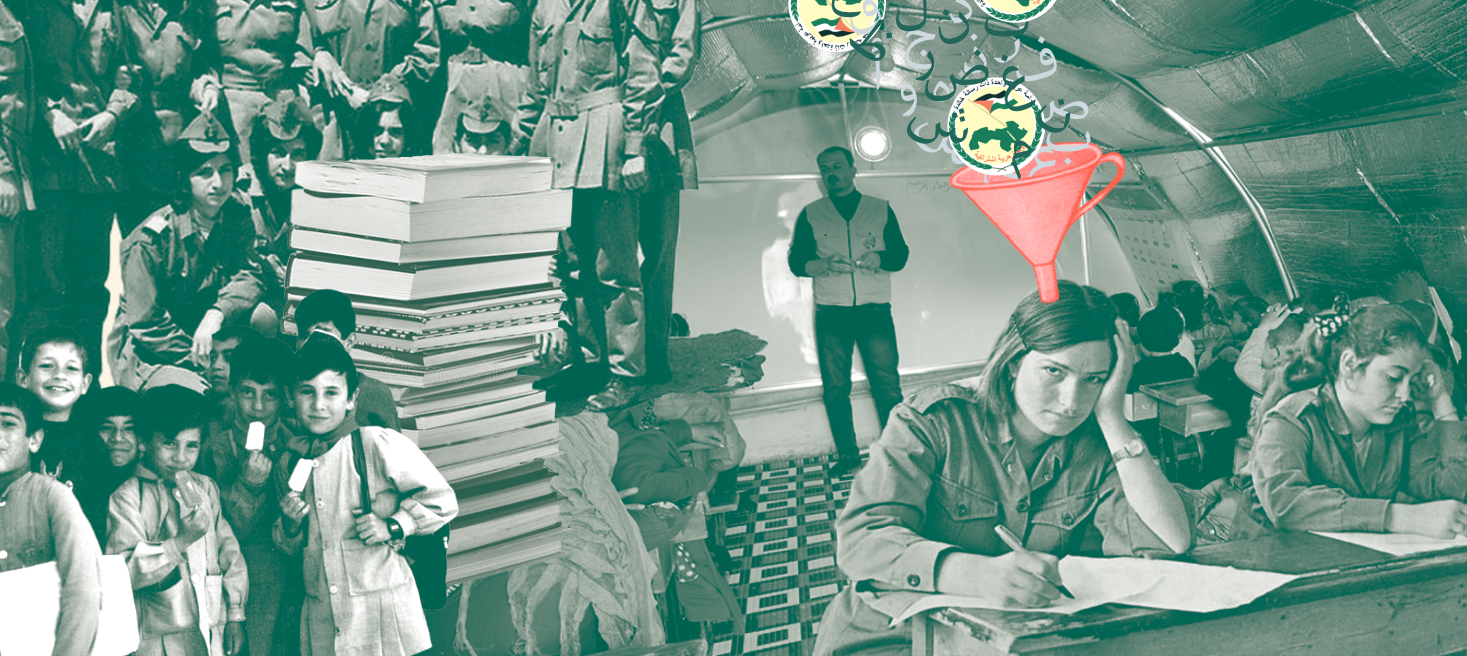
For more than five decades, Syria’s education system was not just a place where children learned mathematics or grammar. It functioned as ideological infrastructure, shaping habits of obedience and defining the limits of what could be said and done. Education in Assad’s Syria produced a particular kind of subject: cautious, conformist, suspicious and accustomed to moral hierarchies flowing downward from a single source of power. If Syria is serious about transition, education deserves far greater attention as it is both an indicator of political will for change and a major lever for allowing a new political culture to take root.
School as training ground for obedience
Hafez al-Assad liked to repeat Mussolini’s maxim: whoever controls the youth controls the future. Whether or not apocryphal, the logic was unmistakable. In Assad’s schools, classroom life was organised to train deference as a habit and to situate students within a patriarchal hierarchy in which authority flowed from the top and defined what it meant to be a “proper” citizen. Corporal punishment was officially banned during Bashar al-Assad’s presidency, but the prohibition was unevenly enforced and in many schools physical discipline remained a routine tool of authority and brutalisation, often encouraged by parents. As one teacher from Damascus told Syria in Transition: “When we called parents in, many would say, ‘The flesh is yours, the bones are ours. Do what you want and raise them.’”
Loyalty was rehearsed through routine rituals: regular flag salutes and recitations that portrayed Hafez as the ‘Eternal Leader’; and a narrative of Bashar as an “exceptional” figure required in times of crisis. Indoctrination did not end with the school year. After completing the tenth grade, students were required to attend a compulsory month-long summer “camp,” usually held in local school buildings, where party ideology was taught alongside basic military-style drills. Top down leadership was presented as an indispensable political necessity; and as the organising premise of social life itself.
Indoctrination as method
The internalisation of hierarchy was also central to the everyday mechanics of teaching. Much of the current debate about post-Assad education is limited to material questions – repairing schools, finding staff, paying salaries – or to curriculum content. While these matter, they are peripheral to the actual didactics.
Central to authoritarian schooling is the way in which knowledge is constructed and evaluated. ‘National Education’ was a mandatory subject so repetitive that students joked one only had to learn it in the first year because the content never changed until graduation. It served as a pedagogical extension of the Assadist personality cult. Memorisation and guided reproduction dominated classroom practice. Discussions took place within tightly policed boundaries: the Syrian nation, led by its Dear Leader, was cast as besieged by the external forces of Zionism and Western imperialism. Alternative perspectives to this worldview were treated as a cardinal sin, while loyalty to its dogma was framed as a civic virtue.
Students were asked to rehearse the regime’s enemy-centred worldview. One National Education exercise bluntly instructed pupils to explain why “homelands are facts that do not allow differing viewpoints.” The same lesson cited Bashar al-Assad as noting that differing opinions among Syrians were natural and normal, “but only until questions of national security arose.” The constant threat of hybrid warfare and terrorism that enemy countries allegedly perpetrated against the homeland meant, of course, that anything and anyone could be a national security concern. Disagreement was indicative of potential involvement in a foreign plot. No wonder that suspicion became a civic reflex and conspiracy theories could pose as insights.
This interpretive lens permeated the teaching of history. The past was not explored for its complexity, but mobilised to explain the regime’s version of the present. Students were encouraged to identify with a lineage of anti-colonial martyrs so that defending the state was understood as a moral duty transcending generations. As Hafez al-Assad asserted: “A martyr is the great human being who made a pledge and remained true to it; when the homeland called, he hastened; when he fought, he showed exceptional courage; when he confronted the enemy, he excelled; and for the sake of the nation’s victory, he chose martyrdom.”
This does not mean that every class was identical, or that every teacher complied. Even within the most tightly controlled systems, there can be cracks. Some teachers quietly introduced alternative perspectives, encouraged questions, or taught ‘between the lines’. “There was a history teacher in middle school who told us that in order to pass exams, we had to learn what was written in the textbooks. But in the classroom, he taught and discussed real history with us. He was killed at the beginning of the revolution,” a woman from Damascus who later became a journalist told Syria in Transition.
Liberation without transformation?
Since the regime’s collapse, teachers describe a palpable psychological shift. Daily loyalty rituals have disappeared. Portraits have been removed from classrooms. The atmosphere, many say, feels lighter. Yet conversations with teachers in recent months suggest that the deeper structure of schooling remains largely unchanged. National Education as a formal subject has been abolished — a move that almost all teachers Syria in Transition spoke to welcomed. But reforms have mostly focused on content adjustments: removing praise of the Assad family, toning down antisemitic formulations, adding references to the revolution.
A closer look at current teaching materials raises uncomfortable questions. Political indoctrination has not disappeared. Under Assad, history textbooks placed the ruler at the centre of the national story. Presidential speeches functioned as milestones and ’primary sources’, while figures from the wider anti-colonial pantheon were framed, along with the regime, as guardians of Arab resistance and, more recently, of the ‘Axis of Resistance’. In post-Assad materials, the Assads disappear as heroic drivers of history, and agency is instead attributed to collective subjects such as ‘the Syrian people’, ‘the Algerian people’, or the ‘the Libyan people’; and the 2011 uprising is presented as a popular revolution rather than a conspiracy.
This revisionism, however, goes only so far. ‘The people’ remains an abstract yet authoritative category, and guided questions still steer students toward a sanctioned moral lesson. Enemy-centred narratives remain powerful. Zionism and imperialism continue to appear as historically constant forces behind regional crises. The language may be less explicitly sectarian, but the notion of a unified external enemy persists. This is not to deny the legitimacy of critically examining colonial domination or Israeli policies within the context of national and regional history. The problem is the construction of a single omnipotent antagonist to which social and political failures can be endlessly attributed. Such framing provides elites with a perfect scapegoat, and sustains a political culture built on antagonism instead of responsibility.
Also not fundamentally unchanged is the didactic model itself. Assignments still prioritise predefined answers, and memorisation remains central. Teachers meanwhile report a growing emphasis on religious instruction. New forms of ideological indoctrination may be replacing older patterns. If, as activist Raed Fares once put it, the regime planted a ‘little Assad’ inside every Syrian, then education is where that internalisation must be addressed.
From indoctrination to autonomous citizenry
All this may appear abstract in a country where many schools lie in ruins and teachers are undertrained and underpaid. Yet postponing didactic transformation risks entrenching old patterns for another generation – and not only among students. Parents, too, learn from their children. Classrooms shape households.
Experience from other societies emerging from authoritarian rule, from Argentina to the former German Democratic Republic, shows that education can become a powerful resource for political liberalisation. But this does not happen automatically, and replacing ideological content is not enough by itself. What matters is transforming the way knowledge is produced, debated, and legitimised in the classroom. Where schooling encourages critical reasoning, plural interpretation, source analysis and reflexive judgement, it contributes critically to the formation of autonomous citizens. The way a country reforms its classroom practice is a reliable indicator of how seriously it intends to move on from dictatorship .
If Syria’s transition is to be more than a change of rulers, education must move from producing obedience to cultivating autonomy. Schools must nurture the ability to engage with plurality, tolerate ambiguity, recognise contingency and accept shared responsibility – the essential attributes of a democratic culture.
Part II of this research will be published next month. Drawing on interviews with Syrian teachers and education experts, it shifts from the classroom to the school itself, examining how discipline, surveillance and corruption shaped everyday school life under the old regime, and what has changed since.