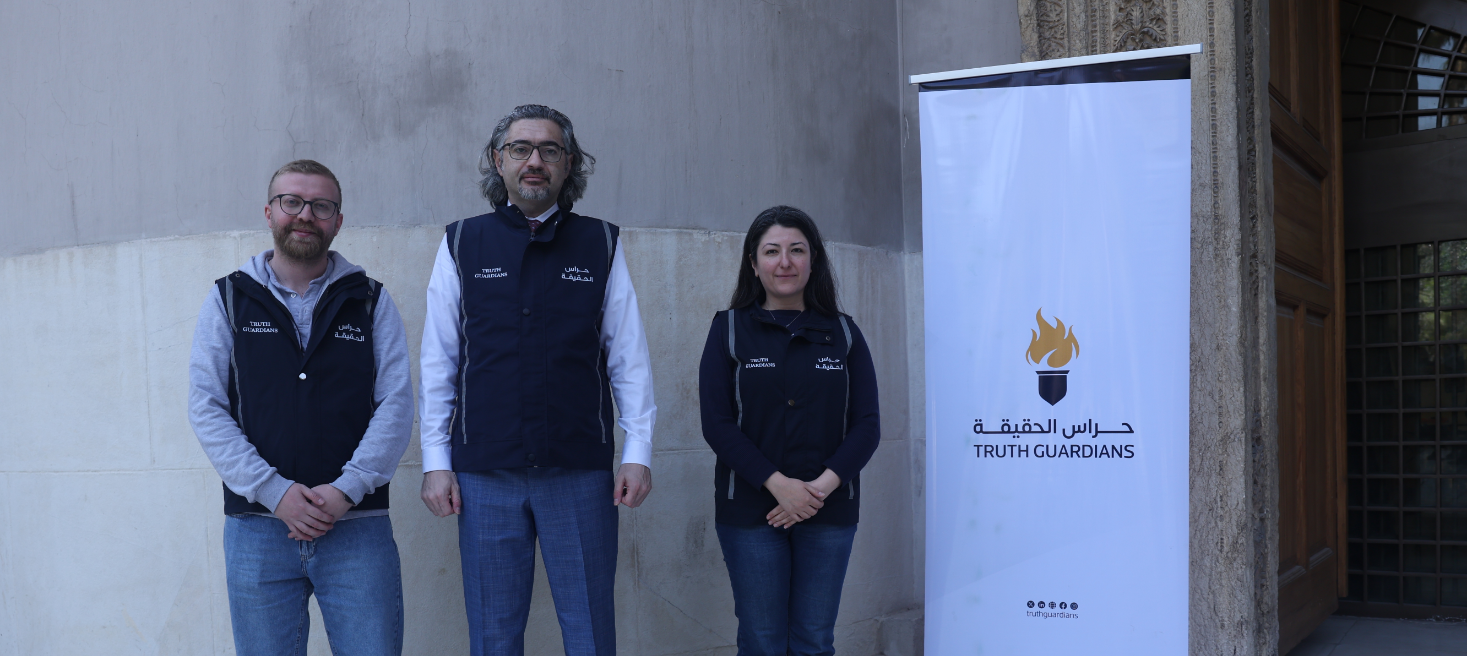
The Truth Guardians
A conversation with Farouq Habib
When the White Helmets’ emergency response service was integrated into the newly established Ministry of Emergency and Disaster Management, remaining structures were reorganised into a new entity: Truth Guardians. The organisation benefits from the White Helmets‘ longstanding donor relationships and credibility amongst Syrians. Truth Guardians aims to play an influential role in Syria’s transitional justice process. To learn more, Syria in Transition spoke with Farouq Habib, a founding member of the White Helmets and Executive Director of Truth Guardians.
For readers unfamiliar with Truth Guardians, could you briefly explain the organisation’s goals and how it has evolved in terms of structure, staffing and funding?
Habib: Truth Guardians is a Syrian-led, internationally supported organisation working at the intersection of transitional justice, accountability and recovery. Our core objective is to contribute to a credible, inclusive and sustainable transitional justice process in Syria - one that addresses past violations, supports affected communities and helps prevent recurrence.
The organisation builds on more than a decade of experience from the White Helmets, particularly in areas such as documentation, forensic response, rehabilitation and community engagement. Following the transition of emergency response functions to state structures, it became necessary to ensure continuity for non-emergency portfolios - especially those related to justice, missing persons and cultural heritage. Truth Guardians was established as a dedicated entity to carry this work forward.
Structurally, we operate across four main programmatic pillars: transitional justice; missing persons, cultural heritage protection; and community resilience and social cohesion. Our footprint spans Syria and Europe, with programme management and support offices in Damascus and The Hague.
In terms of staffing, we have a diverse team of around 70 experienced professionals - primarily Syrians, alongside international colleagues from nine nationalities - many of whom have worked in highly complex environments over the years. This hybrid model allows us to combine local legitimacy and operational agility with technical rigour and international quality standards.
Funding remains primarily project-based, supported by a range of international governmental and non-governmental donors who have supported the White Helmets over the past years. At the same time, we are engaging with partners on more flexible and longer-term funding modalities, including pooled funding arrangements. Transitional justice, missing persons work and institutional capacity-building require continuity. These are not areas where impact can be delivered sustainably through short and fragmented project cycles alone.
On 22 April Truth Guardians signed a memorandum of understanding with the National Commission for Transitional Justice, establishing a framework for cooperation. The Commission’s mandate is limited to crimes committed by the Assad regime. Does your work extend beyond that scope? For example, do you document violations by all parties, including ongoing violations by the government?
Habib: It is important first to be precise about the mandate of the National Commission for Transitional Justice (NCTJ). The Commission’s mandate relates to serious crimes caused by the Assad regime. This formulation is significant, as it can be interpreted more broadly than crimes directly committed by the regime alone. Many Syrians consider that multiple layers of violence and abuse by different actors emerged as a consequence of the regime’s original and systematic crimes.
That said, Truth Guardians is an independent civil society organisation. Our position is clear, principled and impartial: justice and accountability must apply regardless of the identity of the perpetrator or the identity of the victims. The credibility of any transitional justice process depends on the consistent application of standards, without selectivity or political convenience. Our cooperation with the NCTJ should be understood within this framework. We view the establishment of the Commission as an important institutional step, and we are prepared to support it constructively where our experience can add value. This includes technical assistance, documentation and archiving systems, institutional capacity-building and support for the management of international funding.
At the same time, cooperation with a national institution does not mean that Truth Guardians becomes a substitute for that institution, nor does it imply any compromise of our independence. We are a bridge, not a substitute. Our role is to support the development of credible national mechanisms where appropriate, while preserving the integrity and independence of our work.
In practice, our mandate remains broader than any single institutional partnership. We support justice for all victims, and we believe that Syria’s long-term stability depends on a process that is credible, inclusive, and not perceived as selective. This is why civil society remains essential. State institutions have a central role to play, but independent organisations are critical to ensuring that victims’ voices, technical standards and public trust remain at the centre of the process.
The idea that “caused by” could be read more broadly is an interesting interpretation of the Commission’s mandate. Wouldn’t that create a hierarchy of responsibility that could dilute accountability for other actors before formal legal processes have kicked-off? In your discussions with government or Commission officials, have you seen openness to this broader interpretation?
Habib: The concern is valid. Any interpretation that creates a hierarchy of responsibility risks undermining the principle of equal accountability, especially if it is not clearly grounded in law.
In our discussions, senior officials at the NCTJ have informally shared a broader reading of “caused by,” which suggests some openness at the conceptual level. However, informal interpretations are not sufficient in a process of this sensitivity. This is why, in January, we - together with other Syrian civil society organisations - submitted written recommendations on the draft Transitional Justice Law. We cautioned against embedding political characterisations within legal definitions, as this could undermine individual criminal responsibility, expose the law to challenges on impartiality and create interpretive ambiguity.
Our recommendation was to preserve the historical context in explanatory texts, while ensuring that legal accountability is clearly attributed to natural or legal persons, regardless of affiliation, and grounded in international legal standards. Ultimately, the issue is not whether the scope is broad or narrow, but whether it is coherent, impartial, and credible. Without that, there is a real risk of undermining trust in the process.
You have promoted a Build-Operate-Transfer model that positions Truth Guardians as a bridge between civil society and the state: strengthening institutions before eventually handing over ownership. From a donor perspective, this approach seems to have an attractive appeal of “state-building played safe.” What criteria determine when such a transfer is appropriate? The decision formally to integrate the emergency response structure was taken rather quickly. Are matters of transitional justice considered more political and therefore not ready to transfer yet?
Habib: The Build-Operate-Transfer (BOT) model is derived from the successful experience of transferring the Syria Civil Defence to the Ministry of Emergency and Disaster Management. However, it is not a shortcut to state-building that can be applied universally, nor is it a mechanism for civil society to withdraw from its responsibilities. It is a practical sequencing model designed for specific functions in a transitional context - where institutions are emerging, needs are urgent, and specialised civil society capacity already exists.
The concept is straightforward. Where a public-interest function is needed, but the relevant national institution is not yet ready to absorb it, Truth Guardians, within specific areas, can help build and operate that function temporarily, in close coordination with the institution, until conditions allow for a responsible transfer. The success of this approach depends on transparency, inclusivity and mutual commitment. We work with the receiving institution throughout the project cycle - sharing knowledge, systems and operational experience - while also engaging other civil society actors to ensure that the institution benefits from broader expertise. Ultimately, transfer depends on readiness: the institution needs to meet agreed legal, technical and financial standards to ensure sustainability. At that stage, we step back into a supporting role.
A current example is the Documentation and Archiving Team (DAT), which builds on years of White Helmets documentation work and manages highly sensitive material related to truth, accountability and memory. Our approach is to anchor this capacity in Syria, support the development of a comprehensive system within the NCTJ and, in coordination with partners, train and operate it until it can be responsibly transferred under appropriate safeguards.
The integration of emergency response functions was fundamentally different. Emergency response is operational by nature and requires unified command and national service delivery. The Syria Civil Defence (of the White Helmets) was already a fully developed system and became the backbone of the new ministry, making the transition both feasible and necessary. Transitional justice operates under different conditions. There is no fully developed national system ready to absorb these functions, and the work itself is more sensitive. It involves responsibility, victims’ rights, institutional reform and public trust, and requires a sustained role for independent civil society. As a result, not everything should be transferred - and certainly not prematurely.
From a donor perspective, the appeal of the BOT model is understandable. It supports institution-building while reducing the risks of premature transfer. However, the objective is to avoid dependency while enabling institutions. This requires long-term, flexible and coordinated support. Short-term and fragmented funding approaches are not well suited to such institutional transitions.
You highlight the need for close coordination with Syrian institutions and mutual commitment. We’ve heard of recent tensions with the NCTJ over a contract awarded by a Western government to Truth Guardians - with the NCTJ preferring direct funding and viewing Truth Guardians‘ role as intrusive and unnecessary. Is this kind of conflict over resources inherent, and does it undermine effective coordination?
Habib: I am not aware of such tensions with the NCTJ. On the contrary, our relationship with the Commission has been transparent and constructive.
It is important to clarify that Truth Guardians is not the only channel through which international support is provided. Different donors use different modalities: some work through Truth Guardians, others through INGOs, UN agencies or specialised stabilisation and technical partners. This is a normal feature of international assistance, particularly while national institutions are still developing their administrative and financial systems.
As far as I know, no donor is currently in a position to provide direct funding to the NCTJ. Donors therefore rely on eligible partners to channel and manage support, and Truth Guardians is one of those partners - not a bottleneck.
We would welcome direct donor support to the NCTJ whenever donors and the Commission consider it appropriate and feasible. Our role is not to compete for institutional space or resources, but to contribute where we add value. We intervene where our technical capacity, operational experience and civil society role can make a meaningful difference.
With regard to transitional justice - how the new authorities are approaching it, how Syrians you speak with perceive it - what has surprised you the most?
Habib: What has surprised me most is the coexistence of urgency and caution among Syrians. There is a strong and widespread demand for justice. Syrians are seeking truth, recognition, accountability and answers about the missing. They want acknowledgment of their suffering and credible guarantees that past violations will not be repeated. This demand is deeply personal and widely shared. At the same time, there is a clear sense of caution. Many Syrians have experienced institutional failure and are concerned about selectivity, politicization or processes that remain symbolic without leading to meaningful change. There is hope, but it is accompanied by a firm expectation of credibility.
Another important aspect is the diversity of perspectives across Syrian society. Transitional justice is not a single narrative: different communities have different experiences and priorities. Managing this diversity in an inclusive manner will be one of the defining challenges of the process. From an institutional standpoint, there are positive early signals, including the establishment of new bodies and engagement with civil society. At the same time, there is a tension between urgency and the need to build credible systems. Moving too quickly risks undermining trust. Moving too slowly risks losing momentum.
Ultimately, transitional justice is not a single event - it is a long-term process. It requires patience, consistency, and a balance between strengthening institutions, protecting civic space and sustaining international support. The future of transitional justice in Syria will not be determined by one commission, one organisation or one donor. It will depend on whether Syrians can build a process that is Syrian-led and internationally supported, principled, inclusive, and resilient enough to withstand political pressure. This is a complex task, but it remains achievable if approached with discipline and care.