Damascus, the city of nose casts
How social media, changing beauty standards and a new generation of surgeons are fuelling Syria’s cosmetic surgery boom
Cosmetic surgery boomed in Syria during the war years – and the boom continues. We delved into the world of surgeon influencers and social media groups where women search for the right doctor and desperately seek advice about complications; spoke with Syrian surgeons; and visited the first international conference of Syria’s Association of Surgical and Medical Aesthetics.
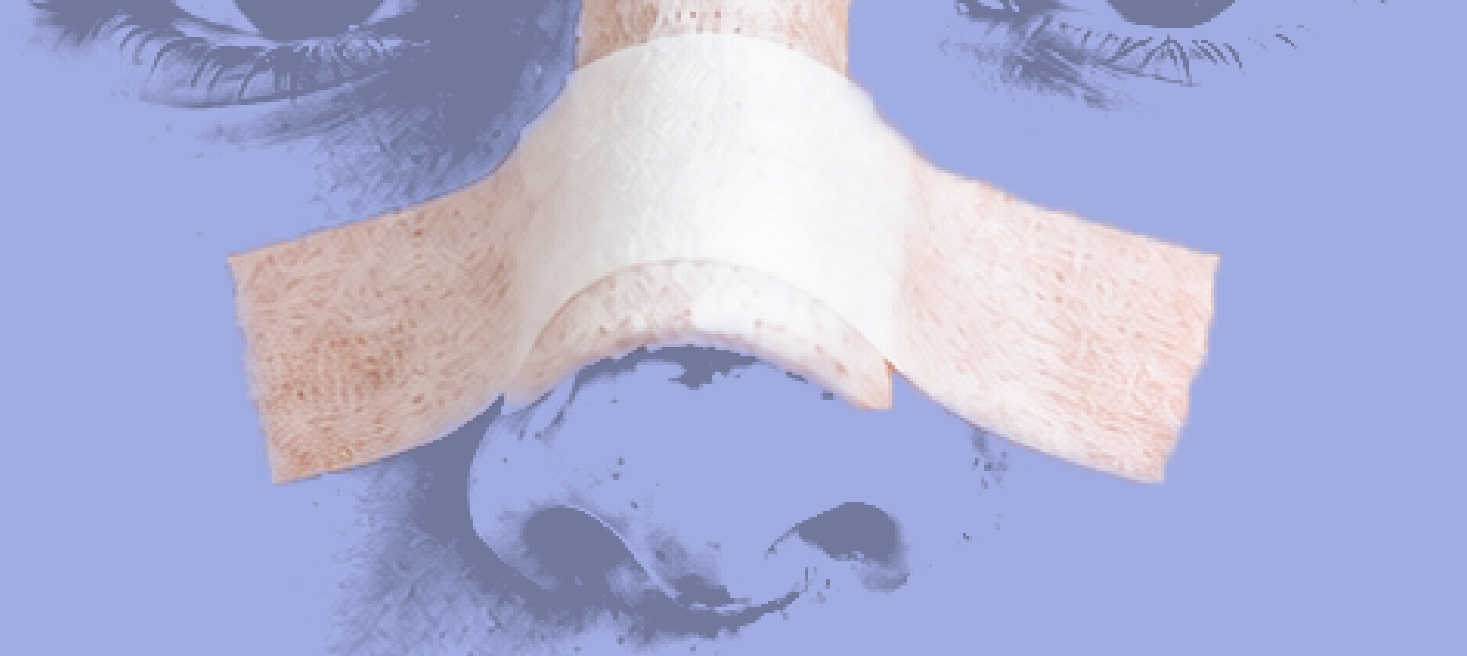
Walk the streets of Damascus today and there’s a good chance you’ll come across a young person with a white bandage or cast taped to their nose – the telltale sign of a recent rhinoplasty. Most are women in their twenties, but it’s also men and even children.
What’s going on?
At around $600-1,500, these operations are relatively affordable, and the presence on the city’s streets of so many post-rhinoplasty nose casts indicates considerable demand and widespread social acceptance.
Online cosmetic advice groups
One of Syria’s largest online cosmetic advice spaces is a Facebook group called ‘wein a’malti tajmeel’ – ‘Where Did You Get Your Cosmetic Work Done?’ It already has more than 155,000 members and attracts around 200–250 new members a week and some 75 posts a day, overwhelmingly from young women. Posts reviewed by Syria in Transition over several weeks in September and October broadly fell into three categories: requests for practitioner recommendations; advice about complications; and questions about particular treatments, ranging from laser hair removal and fillers to liposuction and rhinoplasty.
Women also regularly turn to the group for advice about potentially serious post-operative complications.
“It's been 7 months since my nose job and I feel like my breathing isn’t normal at all. When I go to bed I find it very difficult and I’m unable to sleep because of it. Also for about two weeks, a noise comes out when I breathe, and I swear it's getting more distorted. I go to see the doctor and he says everything is fine but he doesn’t go into detail and keeps it short.”
“Girls, this is my nose one year after the operation. I have swelling above the tip as you can see. It comes and goes. I am putting the ‘blaster’ on it every night and I put two injections of cortisone on it. It worked for a period and looked great but the swelling comes back. I’m going to die. What is this? The doctor is travelling and I don’t want to go to another doctor and have him tell me it needs repairing. I’m super-depressed. The swelling goes down and it looks amazing but the puffiness comes back like this periodically.”
“I've developed a fibrous scar on my nose two months after the surgery. Girls who went through the same thing, what did you do? Please advise if I can get a massage? Is there any hope it'll go away?”
Another recurring theme is suspicion of covert advertising. Women seeking recommendations repeatedly (and annoyed) insist that they want genuine experiences rather than responses from marketers.
“Girls, I've decided to do my nose with [doctor’s name removed]. Dears, tell me about your experiences, without ads, because this is a nose, not a game. I don’t have breathing problems I just want to change its shape...”
“Ladies I want your advice. Advise me which doctor I should get my nose done with. I want a good and natural result and prices that aren’t too high. I won’t forgive any marketer who advertises. I want real experiences, hopefully from girls that can photograph their noses with the name of the doctor. Don’t hold back. 🙏”
“Good evening, ladies. I’d like to ask about [Doctor’s Name Omitted] regarding rhinoplasty. I’m hoping to hear from those who have had the procedure done by him. Please note that I’m not doing this for cosmetic reasons, but rather due to health issues. I truly hope no one posts a comment here just for the sake of advertising – this is already my third time undergoing this surgery.”
Body shame, or unhappiness with various aspects of the body, or a desire to look younger, are also commonly expressed by women in the group. The origins of that shame are hard to assess for individual posters, but in some cases, the event or social pressure that led the woman to post is revealed in comments.
“Ladies, I am 30 years old. Yesterday a 25-year-old-guy called me ‘auntie’ and of course I was super-annoyed and upset and angry. Is it normal that a society calls a girl in her thirties by the word ‘auntie’? What [word] have they left for the [women in their] fifties and sixties? Are there procedures that can be done at this age to make me look ten years younger? Guide me, and consider it your zakat [religious charity].”
Social media surgeons
Advertising disguised as comments in online groups is not the only way cosmetic practitioners are leveraging social media. Some Syrian cosmetic surgeons have built substantial online followings, using their accounts as shop fronts showing tempting before-and-after images of their work. Dr Rami Al-Hussain (who goes by the moniker Dr Rami Rhinoplasty), for example, has more than 70,000 followers on Instagram, and 39,000 followers on Facebook, while several other Syrian surgeons have audiences in the tens of thousands. Dr Imad Hussain (Dr Imad_Rhinoplasty), who has 54,000 Instagram followers, advertises “over 2,000 aesthetic operations” documented through photographs.
These figures are not an indication of the quality of the surgeons’ work, but they illustrate how closely social media and the marketing of cosmetic surgery have become intertwined. There is no suggestion that either doctor mentioned here has engaged in the paid promotional practices discussed below.
A veteran surgeon seeks to bridge a generational divide
Dr Wael Al-Barazi is a consultant plastic surgeon of 25 years’ experience and founding president of the Syrian Association of Surgical and Medical Aesthetics (SASMA). Speaking at his clinic near the Syrian Central Bank, he was forthright about the relationship between social media and Syria’s cosmetic surgery industry. Asked about Facebook groups such as ‘Where Did You Get Your Cosmetic Work Done?’, Al-Barazi alleged that young doctors paid influential people in these online groups to promote them:“They pay thousands and millions of Syrian pounds to get patients.”
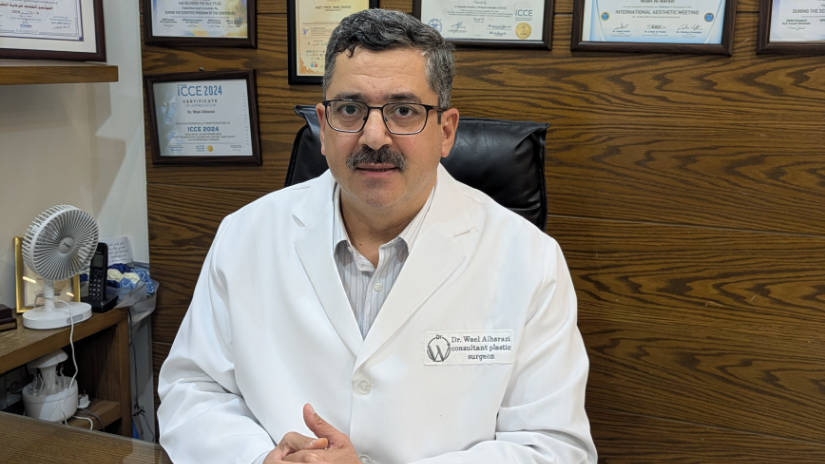
Particularly concerning to him is that some doctors are performing procedures beyond their expertise. “Fifty percent of my operations are reconstructive, and many of those patients come to me to fix work that has been done by other surgeons”, he said. The nose of one patient, for example, had been disfigured by a botched rhinoplasty and three subsequent attempts at reconstruction. Al-Barazi eventually used a large flap of skin from the patient’s forehead to repair the damage. “You can’t imagine her psychological state,” he said. “She was in a bad state and now she’s in a better one.”
He added that in Damascus “some ENT (ear, nose and throat) surgeons do breast augmentations. This is a crime. They are not specialised.”
Yet demand for cosmetic procedures is hardly new. Al-Barazi recalls foreign colleagues assuming that Syria’s war must have caused the industry to contract. His experience was the opposite: “I said no, demand is going up, because of the psychological state of the patients: they want to do something to forget what is going on around them.”
This is supported by a 2022 report from Damascus Medical Association official that cosmetic centers in Damascus had expanded by 80 percent in the previous five years. The nose bandages visible on the streets of Damascus today suggest that demand far from disappeared with the fall of the Assad regime.
Academic research on social media and cosmetic surgery
Academic research supports a link between social media and cosmetic procedures in Syria. A 2025 study of 2,605 Syrians found that those spending more than five hours daily on social media were significantly more likely to consider cosmetic procedures, while following large numbers of fashion influencers was associated with greater dissatisfaction with one’s appearance. Some 76 percent believed cosmetic procedures could help them resemble social media celebrities, while only 19 percent reported verifying practitioners’ credentials.
The findings were “significant and concerning”, said Dr Ahmad Al-Darra, a Syrian surgeon and co-author of the study. “While it demonstrated an association, not a causation, we cannot ignore the link as it shows a pattern and not in a good direction,” he told Syria in Transition.
The researchers recommended tighter verification of practitioners qualifications, screening for body-image disorders, more transparent advertising and media-literacy education to help young people recognise manipulated content and the effects of appearance-based comparisons. Dr. Al-Darra argues that responsibility should be shared. The government should oversee licensing and regulation, and professional associations such as SASMA should establish ethical standards and guidance, while social media platforms should enforce ethical advertising standards and promote media literacy.
Plastic surgeons gather in Damascus
Dr Al-Barazi sees associations like SASMA, which was founded in 2025 and held its first international conference, Beauty Damas 1, on 17-19 October, as a way to guide a new generation of plastic surgeons in Syria.
“The main goal of SASMA is to teach the new generations what is wrong and what is right: standards and ethics”, he said. That is particularly important, he commented, in an age when young surgeons encountered a new technique on YouTube or social media and decided: “OK, I’ll do it tomorrow.”
The conference, attended by 285 surgeons, reflected some of these concerns. Most of its 83 sessions were technical, but several explicitly addressed safety considerations. Dr Al-Barazi spoke about “disastrous complications in plastic surgery”, while UK-based Syrian surgeon Dr Sami Al-Hasan discussed common reasons why rhinoplasty can fail. In the opening masterclass, UK surgeon Dr Omar Tillo also addressed the influence of social media, warning of “unrealistic, filtered results presented as routinely achievable” and “unsafe practices and irresponsible marketing promoted without medical oversight”. One slide offered a simple rule of thumb: “A technician is someone who knows how to operate. A surgeon is someone who knows when to operate. And good surgeons are those who know when NOT to operate.”
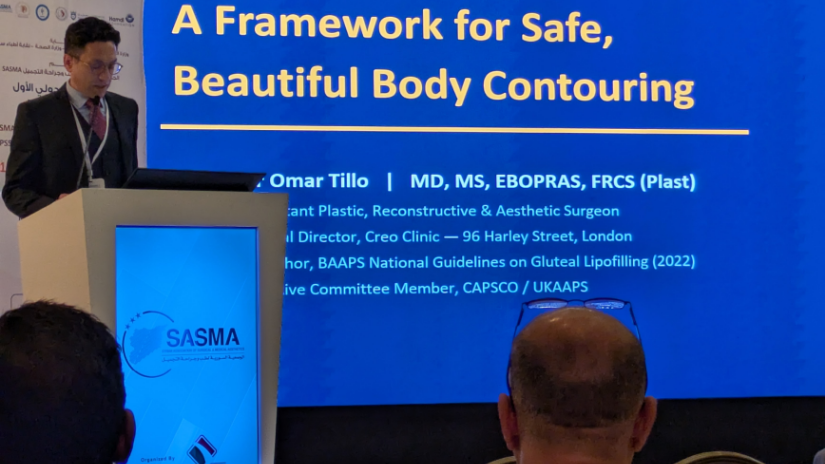
The emphasis on safety was encouraging. Yet the conference programme largely left untouched the broader social and ethical questions surrounding Syria’s cosmetic surgery boom: the beauty standards and pressures driving mostly young women to want to change their bodies, the role of online advice groups and the ways surgeons themselves use social media to attract patients. Nor is it clear how far the warnings of experienced practitioners like Dr Al-Barazi will reach those operating beyond their expertise.
A female medical student in her final year in Damascus, who preferred not to be named, was blunt in her assessment: “Cosmetic surgery is trendy. Some women do it to show off that they’ve got money; some are pretty but suffer from a lack of self-esteem. It’s purely materialistic thinking, and people are like a flock of sheep, standing in line to get a procedure done without thinking about future complications.”
She added that the same trend had taken hold among doctors, distorting what she considers the field’s original purpose of helping people with deformities caused by injuries and other conditions. “These days, everyone wants to work in aesthetics. Whenever someone asks me what I want to specialise in, they tell me: ‘Specialise in aesthetics – make some money.’”