The Uyghurs who went to war
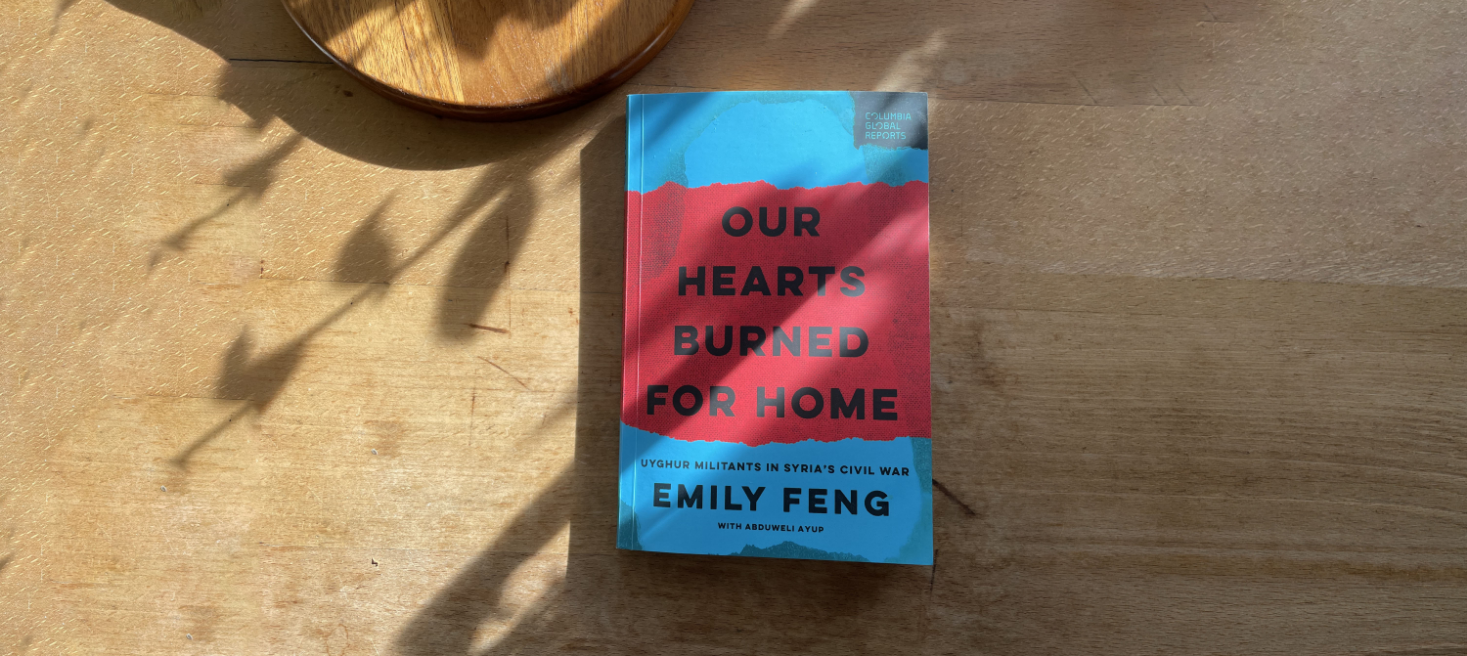
A review of Emily Feng’s book ‘Our Hearts Burned for Home: Uyghur Militants in Syria’s Civil War’
Based on dozens of interviews with Syria’s secretive Uyghur community, Emily Feng provides the most comprehensive account to date of those who left their home in Xinjiang, fleeing an oppressive Chinese state, to organise, arm themselves and prepare for an eventual return. It is a compelling read because, for once, Syria’s Uyghurs are doing much of the talking themselves. Beyond this wealth of first-hand accounts, the book leaves crucial questions about access unanswered and says little about the arrangements between the Uyghurs and their long-standing allies in HTS, but it certainly provides the material to start asking them.
Living in constant fear of Chinese surveillance, Uyghur militants in Syria form a particularly secretive community. Despite how little is known about the estimated 3,000-4,000 fighters and an additional 15,000 family members, they have acquired a reputation as perhaps the most “tame” of Syria’s foreign fighters: highly disciplined, not into global jihad and willing to obey the rules of their hosts while maintaining their own culture. That image may resonate especially well with Western audiences since much of it resembles the cliché of the model Chinese immigrant, as opposed to the Arab “troublemaker”. The Uyghurs are a Turkic people, and they – at least not those in Syria – would not consider themselves “Chinese”. Syria’s Uyghurs, organised in the Turkistan Islamic Party (TIP), are also known to be fiercely loyal to Ahmad al-Sharaa, under whose command they spearheaded the offensive on Aleppo in November 2024 and then marched towards Damascus, only to retreat quietly to their settlement areas around Jisr al-Shughur in Idlib province once al-Sharaa gave the order. They are usually portrayed as one homogeneous mass, which certainly has something to do with the secrecy surrounding their communities: most talk is about them, not with them.
Emily Feng, supported by Uyghur linguist Abduweli Ayup, attempts to change that with her book ‘Our Hearts Burned for Home: Uyghur Militants in Syria’s Civil War’, published in October 2026 by Columbia Global Reports. The publisher is clearly a good match because reporting is what the book does. In a prologue and six chapters spanning a brisk 117 pages, Feng – a National Public Radio (NPR) correspondent – presents the curated essence of around 60 interviews she conducted with Uyghurs in Syria, and some who had already left the country, in the summer of 2025.
The road to Syria
The chapters begin chronologically with accounts of humiliation and deadly violence in Xinjiang, the Chinese province home to the Uyghur Muslim minority. For Feng’s interviewees, these experiences led to a nationalist and religious awakening and the conclusion that the threat to themselves and their people was existential. The overwhelming power of the Chinese state and its chauvinistic and racist wrath meant that emigration and organisation abroad appeared to be the only option, and for those who regarded existing international Uyghur organisations such as the World Uyghur Congress as paper tigers, learning armed resistance and gaining access to weapons was the way to go. Most of those who would later find themselves in Syria had experienced particularly brutal episodes such as days of raging violence between Uyghurs and Han Chinese in 2009 after Uyghur protests in Xinjiang’s capital were violently dispersed. One interviewee recalls watching a Han Chinese mob drag a Uyghur family from their car, beat them, force them back into the vehicle and set it on fire.
This generation, however, was not the first to conclude that armed resistance required looking abroad. The previous generation had already been influenced by political Islam and jihadist ideas brought back by Uyghur pilgrims returning from the Hajj in Saudi Arabia in the late 1990s. They began looking for places where they could train and arm themselves, eventually finding their way to Afghanistan and Pakistan. It was in this milieu that the al-Qaeda-aligned East Turkistan Islamic Movement (ETIM), also known as the Turkistan Islamic Party (TIP) emerged. Feng stresses that ETIM/TIP in Afghanistan – designated as a terrorist organisation by the UN, US and EU – never really was a functioning organisation but a loose network of scattered fighters. China conveniently used its existence to label Uyghur resistance to Communist Party rule as terrorism, drawing on the language of the US-led “war on terror”, which gave governments around the world a ready-made justification for repression. Members of the old guard in Afghanistan moved to Syria in about 2012, where they served as leaders and trainers for a new generation of Uyghur militants who, having crossed the border from Turkey, found in Syria a sort of Wild West where they could organise, arm themselves and learn how to wage war.
Learning war
There followed years of brutal warfare, which Feng reconstructs in vivid detail from her interviews. Large portions of the book consist of direct testimony from fighters, alongside a smaller number of non-combatants including several women, who are portrayed as deeply immersed in the highly militarised culture Syria’s Uyghurs developed. One fighter gives his wife a pistol as a wedding gift, and when she practises shooting, she imagines firing at “Xi Jinping, the pig”. Military drill is total, designed to “physically and mentally wear a person down and then build them back up”, as one commander puts it. The toll of these baptisms of fire is immense: some fighters are initially paralysed by fear and sometimes cry from loneliness and hardship; but dedication ultimately prevails, they say, because the goal of liberating their homeland is everything, and they know that fighting a heavily armed, technologically sophisticated cyberocracy like the Chinese regime will be a confrontation of an entirely different magnitude from the Syrian conflict. It is moving to read later in the book how wounded fighters in hospital, under anaesthetics that seem to break down their iron self-control, cry uncontrollably.
How the TIP ended up settling around Jisr al-Shughur; how the jihadist schism between ISIS and the Nusra Front tore into the TIP itself; how Russia’s military intervention in 2015 brought new levels of carnage; and how the advance of the Assad regime and its Iranian and Russian backers was ultimately checked by the Turkish-Russian ceasefire of March 2020 that stabilised the front lines – all these landmarks of the Syrian civil war are narrated from the perspective of the Uyghurs. It makes for insightful reading and vividly illustrates phenomena that extend well beyond their particular story: the camaraderie that war can produce and the fragile sense of belonging and equality that collective trauma can give a community; the order and certainty that strict Islamism can offer when everything else is falling apart; and the disorientation that sets in once the guns fall silent.
A major theme is the TIP’s moderation under a younger generation of commanders. Central among them is Choghtal, the book’s main protagonist, with whom it begins and ends. Now 36, he serves as second-in-command of the 84th Division of the Syrian Army, which was created largely to absorb foreign fighters. Another is Abdulaziz Dawood Kuhdaberdi, an Afghanistan veteran portrayed as having supported the split from al-Qaeda and the alignment with HTS who today commands the 84th Division with the rank of brigadier general. Feng tells a story of evolution. The commanders she interviews say they came to realise that radical Islamism would alienate both their own people and the international community, whose support they would ultimately need to complement their military capacity if their dream of an Uyghur nation state was ever to come true. Some explicitly cite Zionism as a model. TIP’s break with al-Qaeda in 2018 came shortly after the creation of HTS and was inspired by it, according to the commanders.
Access granted
Feng writes that in early 2025 she approached Syria’s Ministry of Information for permission to interview Uyghurs, but was turned down. The foreign-fighter file – and the Uyghur question in particular – was highly sensitive. China was hyper-focused on their presence in Syria, while the new government in Damascus still needed Beijing not to block a lifting of UN sanctions on Ahmad al-Sharaa and HTS. Access eventually came through Abduweli Ayup, the Uyghur linguist who assisted Feng and had direct contacts with Uyghurs in Syria. In the summer of 2025, “all the Uyghur groups” were suddenly open to interviews, and she and Ayup conducted dozens in the course of a month-long visit. It is likely that interviews on this scale, including with senior commanders who now serve in the Syrian army, would not have happened without a green light from Damascus. This is, after all, a well-organised community that takes the threat of Chinese espionage so seriously that in spring 2025 Uyghur locals beat a group of Chinese “tourists” bloody when they tried to visit Uyghur villages in northern Syria, as Feng recounts. That does not mean that the interviews were orchestrated or that the accounts are untrue; but it does raise the question of whether at least some of the interviews, particularly with senior commanders who stress the need to gain international support, should be understood as an exercise in strategic communication. The book would have benefited from addressing the issue of access and sourcing more directly, especially since Feng rarely contextualises or comments on the narrative provided by her interviewees. This type of narration – presenting the accounts with relatively little contextualisation or commentary – is never neutral, since the material presented to the reader is itself selected. Feng anyway does not pretend to be neutral. In the prologue, she foreshadows what the future may hold in Xinjiang: “What several thousand highly motivated, highly experienced Uyghur fighters can do may end up surprising us all. They have already surprised me.”
Waiting for the right time
When they enter Damascus, Uyghur fighters are described as weeping as they think of home. Choghtal gives a speech promising that the liberation will continue in Xinjiang. Another fighter describes how one of his comrades begins hallucinating as they enter Latakia, believing that he is returning to his home town. An old heart condition returns, and he dies of heart failure that same night. Feng’s accounts leave little doubt about the enormous importance the fight against Chinese occupation still holds for these men and women. Equally intense are their fears that their children, who know their homeland only through stories, will forget the cause, and that the agenda of “waiting for the right time” could become a convenient slogan that in reality means inaction. In any case, an Islamist group drilled into total obedience (one Uyghur woman describes it as the “worshipping of leaders”) and built around the goal of liberating Xinjiang – or East Turkistan, as they call it – is unlikely simply to call it a day.
It is unclear how the Syrian government has managed to placate Beijing, and whether al-Sharaa has promised to keep an eye on the Uyghurs and otherwise satisfy China’s obsession with surveillance. It would not be an entirely novel challenge for him. He kept jihadist factions in Idlib under control while information about them was passed to the US-led coalition. What remains unresolved is what that might mean for the heavily armed Uyghur community, which is still finding its place in the new Syria while grappling with what that means for the cause that brought many of them there in the first place. Many such questions arise from Feng’s book. Whatever the answers, it will almost certainly become a major reference for anyone trying to understand Syria’s Uyghurs.