The Great Humanitarian Recession
Blended finance may offer help beyond grants and without illusions
The humanitarian sector is facing a reckoning. For decades, assistance to the most vulnerable populations relied on a single, fragile mechanism: annual grant mobilisation. That model is now under severe strain: global humanitarian funding contracted by around 35 per cent in 2025 and is expected to decline further in 2026.
The Great Humanitarian Recession is already a reality. This is no longer about temporary funding dips or cyclical shortfalls. The volume of grant capital available is unlikely ever again to match the scale of global needs. In other words, the era of fully grant-funded aid is over. The consequences for Syria are stark. Almost 65 per cent of the 2025 humanitarian funding requirement remains unmet. Two-thirds of Syrians depend on some form of aid, and millions continue to live in camps and informal settlements. For many, the funding cliff threatens to sever basic lifelines altogether.
The humanitarian sector in Syria should be pushed into new territory. The challenge should no longer be just how to prioritise shrinking grants, but to determine whether parts of the system must move from grants to financing to sustain critical interventions. Blended finance may offer tools to extend reach and durability - but only if deployed without illusions about what it can, and cannot, replace.
A drop in the ocean is not too little
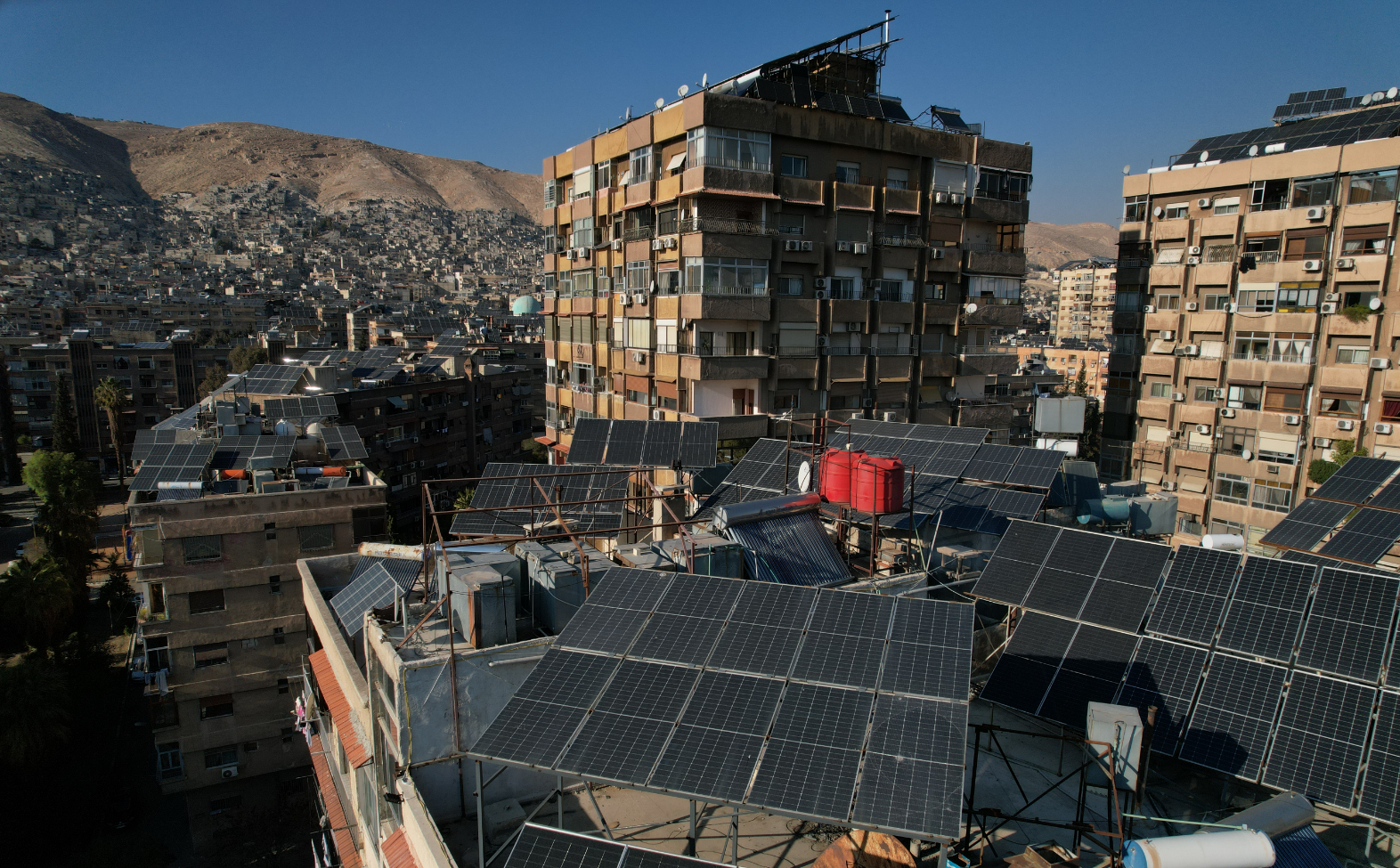
Blended finance is not a new pot of free money. It is a way of using public or philanthropic capital to take on risks that private investors will not. By sharing losses, offering guarantees or lowering expected returns, it makes projects possible that would fail on commercial terms alone. An oversimplified example might involve donors working with local NGOs and Syrian solar firms to install off-grid power in isolated communities: grants cover part of the upfront infrastructure costs and early losses, while private operators invest alongside them and commit to affordable prices. Public capital carries part of the risk for the private actors to invest in the services.
Globally, blended finance deals total $15 - $18 billion annually (including both concessional and non-concessional capital). This compares with World Bank Group commitments of $100 - $120 billion annually. Most of these deals involve climate mitigation and large infrastructure projects and most are in stable, middle-income countries.
In contrast, Fragile and Conflict-Affected Situations (FCS) receive roughly $1 billion annually, mostly for conventional projects such as infrastructure development Only a very small portion of this $1 billion is linked to exclusively humanitarian objectives. The difference between stable middle-income countries and FCS is also underlined by the ratio of non-concessional capital leveraged per $1 of concessional capita. There is no set standard but this averages $2 and $4 per $1 of concessional capital, although $1 - $10 is not unheard of. In FCS contexts, this ratio drops as low as $1 to $1. That is not bad news for Syria. In oversimplified terms, it means that the same project can be undertaken for almost half the price.
Is it applicable? Is it risk-free?
Blended finance is complex; but complexity does not make it unsuitable for countries like Syria. On the contrary: complex problems often require complex tools. While blended finance remains rare in humanitarian settings, where it has been used it has most often supported the provision of essential services. In the early 2010s, for example, it was applied in Somalia and Kenya to sustain water and electricity services in low-income areas amid insecurity and the collapse of public utilities. This does not mean blended finance is inherently limited to essential services; rather, it reflects how little exploration has taken place in other sectors.
In Syria, such exploration has already begun—if only tentatively. In 2024, a group of Syrian NGOs, anticipating severe funding cuts, held a series of discussions and workshops on financing healthcare. Although these talks did not translate into concrete projects, engaging the private sector and considering instruments such as blended finance emerged as key priorities. The fall of the regime, the scramble to re-establish operations in Damascus and a temporary surge in grants and donations brought these discussions to a halt. Given current funding trajectories, however, it is likely that such debates—whether collectively or within individual organisations—will soon resume.
Like almost everything else in Syria, blended finance is not without risk. Where incentives are misaligned and accountability weak, financing arrangements can end up socialising failure while privatising success: public or donor capital suffers losses while profits accrue to private investors. In the Syrian context, this raises the spectre of figures akin to Rami Makhlouf benefiting from protected investments under blended structures - a risk that applies equally to humanitarian and development projects.
Even with well-intentioned actors and sound incentives, another pitfall looms: de-risking projects that would have gone ahead anyway. For this reason, blended finance was widely criticised in the 1990s and early 2000s as little more than a subsidy in disguise—even when directed at the “right” actors.
Ethical considerations
Ethical tensions are unavoidable. Humanitarianism is based on need while financing introduces ability to pay. In settings where household incomes are decimated, even modest cost recovery can create barriers to access. The challenge is preventing financial viability from overriding humanitarian purpose. How can a family in a camp or a destroyed neighborhood afford to pay for services? And how can an investor be persuaded to risk money they can only recover through subsidies? Another ethical concern is how to determine who gets subsidised and who does not? And, more generally, how to preserve humanitarian principles, given Syria’s record of weaponising aid and exploiting humanitarian actors?
Governance is critical. Such complex transactions require clear terms, roles, responsibilities, and risk allocation. Who absorbs losses, who captures returns, who decides what and who enforces agreements are fundamental questions.
Finally, institutional culture matters. Humanitarian mandates emphasise neutrality and process; private actors prioritise speed and cost control. Blended finance brings these cultures into direct conflict. That said, the biggest hurdle to adopting any type of alternative financing is the dominant NGO culture, that resists any shift from annual appeals. While humanitarian principles are non-negotiable, NGO’s internal systems, practices, and partnership structures must change. Financial literacy is no longer a luxury.
Designing for equity
Any discussion of blended finance as an instrument for the humanitarian provision of essential services in Syria must start from present realities. The population’s ability to pay for basic services is extremely limited. Investing in infrastructure in areas hosting the most vulnerable populations, such as camps, rural areas, and heavily damaged or poor urban neighborhoods, is not attractive for service providers and often exceeds the government’s capacity. At the same time, structuring blended finance transactions for large infrastructure projects is itself costly. It requires sophisticated studies covering engineering, environmental impact and urban and rural planning, as well as complex financial structuring that demands highly specialised expertise.
The viability of blended approaches, however, rests increasingly on who is involved. It should therefore be seen as part of a broader effort to engage the private sector differently. Central to this are Syrian businesspeople and high net-worth individuals, both within the country and in the diaspora. Many are not motivated solely by profit or financial returns. They can bring affinity, responsibility and a willingness to contribute.
Since the fall of Assad, Syrian business actors have financed the rehabilitation of hundreds of schools and hospitals, maintained water wells, provided solar power systems and supported a wide range of other essential interventions. If these same activities had been implemented by NGOs, they would have generated pages and pages of impact reporting and documentation. Misinterpreting such engagement simply as charity is a mistake. Rather, it reflects a genuine interest in investment and in giving back to the country. Humanitarian organisations should not approach these actors primarily as sources of funding, but as partners. Blended finance might be an ideal means of structuring such partnerships responsibly and at scale.
Blended finance is neither a solution to the aid shortage nor a substitute for aid. Its relevance depends on careful design, the right actors, and governance arrangements that do not disguise subsidies or fully shield investors from risk. When used as a shortcut to Syria’s structural realities, blended finance will fail the very people humanitarian action is meant to serve. Where used narrowly and deliberately, it may rescue essential services that otherwise could collapse.
This analysis was provided exclusively by Strategic Ventures Advisors, an investment and economic advisory platform.