Young, motivated, struggling
Syria’s returning workforce faces a broken labour market
Productive know-how lives in complex networks of firms, suppliers, and professional communities. After being shattered by war, that collective capability remains fractured. Human capital can grow again, but only in an environment of stability and clear rules. The government and private sector should rethink how they rebuild human resources capacity; and donors how they invest in it.
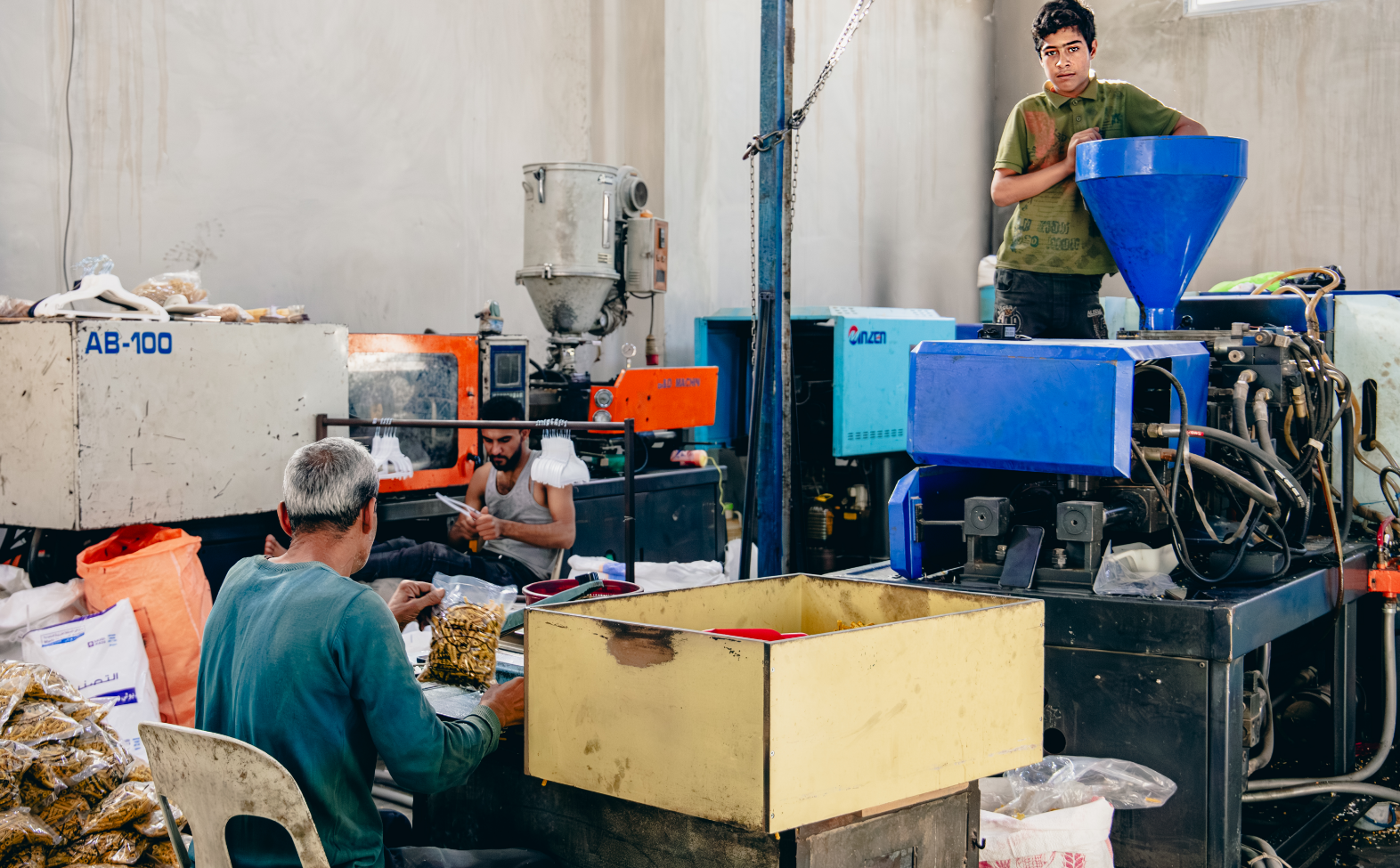
For many Syrians returning home or entering the labour market for the first time, the starting line is already tilted against them. The economy has been shaped by scarcity: unemployment remains painfully high, firms operate with limited capacity, wages have collapsed, and entire sectors rely on pre-war equipment. Informal measures fill the gaps where public services have failed. The pressures weigh on everyone but fall hardest on marginalized groups such as women, rural youth, and people with disabilities. Those leaving armed groups also face special challenges, having to navigate the political sensitivities surrounding disengagement, disarmament and reintegration (DDR).
In such a context, a young Syrian or a returning expatriate is not merely job-hunting; he or she is stepping into a labour market that struggles to recognise or reward skills, let alone nurture them. Most firms are still oriented around survival. Operating routines built during the conflict persist because they are familiar and low-risk. The result is a labour market that cannot absorb talent at the scale recovery demands, and where opportunities to learn, adapt, and advance remain scarce.
This creates a vicious circle: economic recovery depends on human capital, but human capital deteriorates in an environment where businesses cannot expand and workers don’t see prospects for career growth. In economies where incomes rise and institutions stabilise, people stay, return, and accumulate skills over time. In stagnating economies, they leave – or return only temporarily – and the base of knowledge inside the country erodes further.
Four groups of returnees
Who returns to Syria shapes what is possible. A limited number of skilled returnees spent years abroad upgrading their qualifications, learning new technologies, and working in competitive markets that value efficiency and innovation. These are the engineers, doctors, IT specialists, technicians and managers that bring valuable experience from abroad. Today, they enter workplaces that often lack the systems, technologies and management structures needed to make best use of what they know.
By far the largest category of returnees are those who worked abroad in construction, agriculture, retail, or other low-skilled sectors. They come home to wages that bear little resemblance to what they earned abroad, to rental markets strained beyond capacity, and to competition with workers who adapted to crisis-level conditions.
Another group hovers between home and abroad. These hovering returnees maintain residence or employment elsewhere and come back periodically to explore job openings or build connections. Because they do not rely on Syrian salaries, they can target selected roles – especially in banking, telecommunications, NGOs and donor-funded programmes – intensifying competition at the upper end of the labour market.
A large share of the most highly skilled Syrians, however, remain abroad entirely. Doctors with stable posts in Germany or the Gulf, engineers in Europe, IT specialists in the United States see no future inside the country for now, and their absence represents the country’s deepest structural loss.
The business community mirrors these same dynamics. Major investors who relocated operations to Turkey, Egypt or the Gulf are testing limited returns but remain wary. Small and medium entrepreneurs who built businesses abroad face even harder choices: relocating to Syria would mean entering a fragile market with unreliable infrastructure, uncertain regulations and unpredictable political conditions. Many experiment with hybrid arrangements, keeping their core operations abroad while taking small steps inside Syria. Even these partial returns, however, put pressure on local firms that survived the conflict and now face competition at a moment when their ability to take risks is extremely limited.
Fragmented human capital
Human capital is reshaping itself, but not coherently. Skilled returnees often earn more than domestic workers even after taking steep pay cuts. Local staff worry about being passed over for promotion or replaced. At the same time, returnees struggle to navigate the informal systems and administrative improvisations that emerged during the war. Without institutional support, much of their expertise remains dormant. Low-skilled returnees confront a labour market that cannot offer upward mobility. Circulating returnees compete for the few high-quality jobs. A further problem is that remittances – one of the few stable sources of liquidity for households – may shrink if large numbers of low- and middle-income Syrians return for good.
The fragmentation of know-how is another profound problem. Modern economies rely on capabilities that reside not only in individuals, but in firms, supplier networks, and professional communities. In Syria, that ecosystem was disrupted: part of it left, part decayed and part survived in improvised form. Capabilities exist, but they do not reinforce one another. Skilled returnees cannot fully apply their knowledge, local workers cannot upgrade theirs, and firms lack the organisational systems to translate scattered expertise into productivity. Everything exists, but not together, and not under conditions that allow growth.
Still lacking, meanwhile, are the crucial foundations that make skills meaningful: predictable rules, reliable institutions, functioning courts, stable electricity and water supplies, transport networks that support commerce, and social protections that allow people to plan their futures. Workers must believe that building a career inside the country is not an act of self-sacrifice.
Boosting human capital
The government should enforce predictable rules, strengthen essential services and remove specific barriers that prevent firms from growing. It should protect small and medium enterprises, ensure fair hiring, and align training systems with labour market needs. Donors, for their part, should shift away from broad training schemes toward investments that build real productive capabilities inside firms and public institutions. That may include targeted technical assistance, upgrading technology, and direct engagement with diaspora expertise that can be plugged into actual economic activity. And the private sector, long shaped by the defensive habits of war, should modernise operations, improve management practices, and create ways for workers to build skills inside real production environments.
More than 1.1 million Syrians have returned to the country since the fall of the Assad regime, almost half of them of working age. Some return because they believe in rebuilding their country; others because conditions abroad have deteriorated. Syria’s human capital is reassembling, piece by piece, across borders and inside the country. Whether it becomes a foundation for recovery or a victim of continued stagnation depends on the government, the private sector and external donors coming up with joined-up approaches.
This analysis was provided exclusively by Strategic Ventures Advisors, an investment and economic advisory platform.