Justice without a map
A conversation with Stephen Rapp
Amid doubts over whether more than a small fraction of the crimes committed in Syria since 2011 will ever be prosecuted, Syria in Transition has conducted two interviews with Stephen Rapp, former US ambassador-at-large for war crimes and current chair of the Commission for International Justice and Accountability (CIJA), to explore what can and should be done.
While Syria’s justice minister publicises a flurry of meetings with foreign diplomats, victims of atrocities still have little sense of whether any coherent plan exists for prosecuting the vast range of perpetrators. These include not only Assad regime senior figures, but also thousands of mid-level commanders, security officers, militia leaders and combatants. For many Syrians, the question is not just what happens to a handful of “worst offenders”, but how a transition will deal with an entire strata of individuals who may pose personal and communal risks.
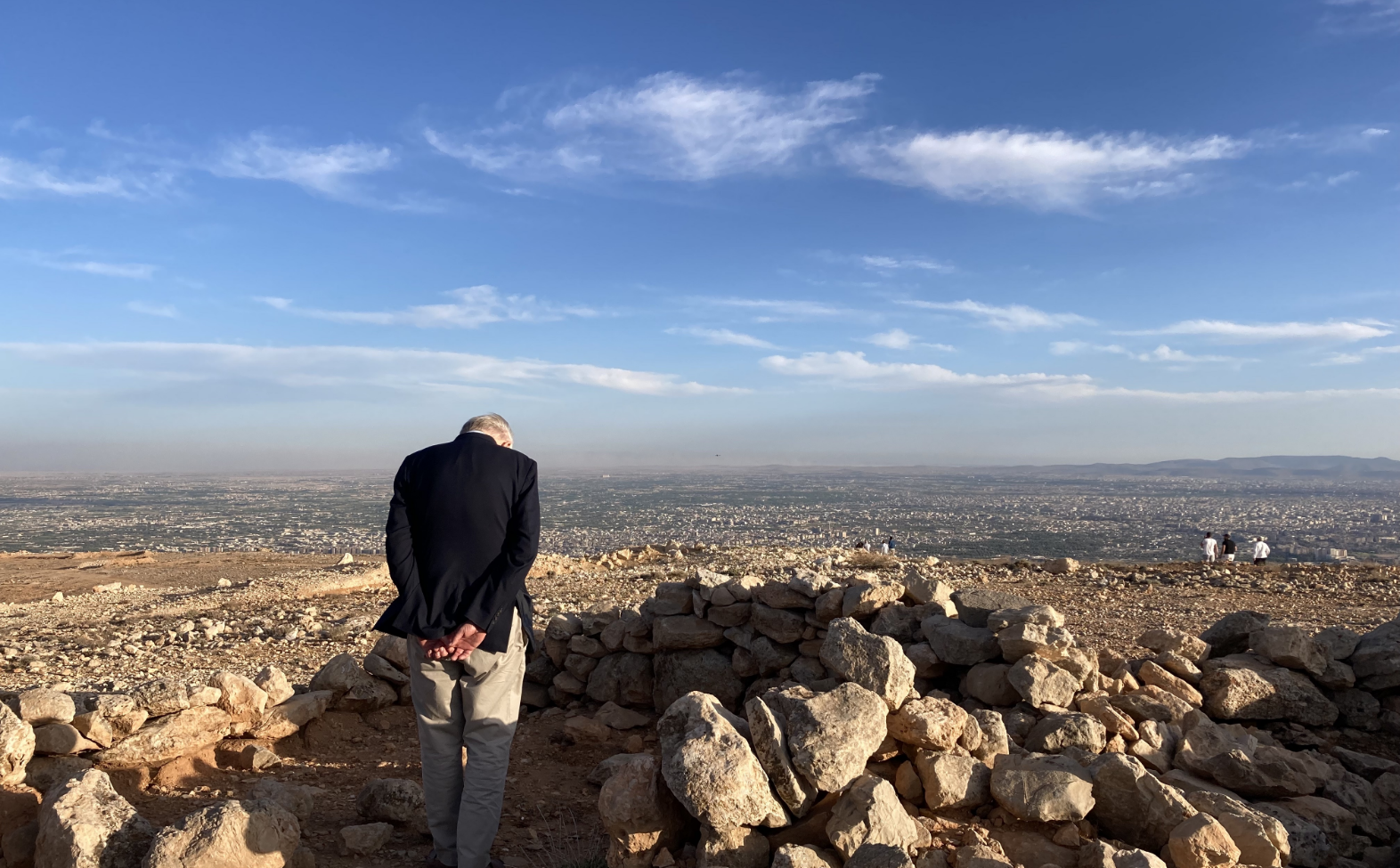
“The priority after this horrible period of mass atrocities - the worst of the 21st century – should be establishing the truth,” Ambassador Rapp told Syria in Transition after visiting unexcavated mass-grave sites north of Damascus in late April. The site was located only after locals helped identify a man who had driven a truck of bodies to that lonely, windswept hilltop more than a decade ago.
“And then, based on that truth, move forward with justice and accountability,” he added.
The most definitive evidence, he stressed, lies in the former regime’s own paperwork. “CIJA holds 1.3 million documents taken from intelligence centres that fell to the opposition,” he said. “But overall there are roughly twenty million pages that must still be scanned, digitised and analysed.”
A missing strategy
By September, in a second extended interview in Damascus, Rapp’s tone had sharpened. What concerned him most was the absence of a roadmap.
“Frankly, when you have people detained, you should be moving forward with the case,” he said. “If someone is detained for two years while it is still being decided how to proceed, there needs to be a process they can look forward to.”
He also explained the rationale of applying international law. “To prosecute someone in Germany for crimes committed elsewhere, you must establish that the acts were international crimes — crimes against humanity, part of a widespread and systematic attack. That’s why, in the Anwar Raslan case, the court first had to establish the nature of the crime itself,” he said. “International law exists everywhere – by treaty and by custom – so any court with jurisdiction can apply it.”
But not all cases require this bar. “Often you can prosecute large-scale criminal conduct using ordinary domestic law,” he said. “Some may complain that the term ‘crimes against humanity’’ isn’t used, but you can still get accountability.”
Public communication
CIJA officials have met repeatedly with Syrian government ministries in recent months, and Rapp describes a system trying to navigate practical realities.
“The interior and justice ministries are thinking practically. They have around 6,000 detainees. Their instinct is that many may need to be released, but they need to determine the approach.”
Saying so publicly, however, is difficult. “Whenever someone says ‘we won’t prosecute everybody,’ there’s an outcry,” he said. “From my meetings with victims, perhaps half want everyone prosecuted. Others say only the major perpetrators.”
His experience in international tribunals has taught him the importance of public clarity. “In Sierra Leone we constantly went out into communities and explained why we prosecuted one person and not another,” he recalled. “We held meetings with thousands of people. We explained who we had the mandate to charge, and who fell outside it.”
In Syria, the early post-Assad period was shaped by confusion. “At first, former regime members were being told: don’t leave the country, just stay put,” he said. “Then some who tried to leave were detained. But detention doesn’t automatically mean there is enough evidence.”
The principle, he stressed, is simple: “You can’t hold too many people for too long. If someone was a combatant and still poses a threat, you may be justified in holding them, but not indefinitely. Strategy matters.”
Building a legal framework Syrians can trust
“There aren’t the resources to investigate everyone,” Rapp said. “And trials in absentia require retrial once a suspect is arrested.”
This makes prioritisation and legal clarity essential.
“There needs to be a decision on the statutory framework,” he said. Passing new laws retroactively is sensitive, but “you can adopt a retroactive law at the national level if it simply codifies the Law of Nations that applied at the time.”
Some Syrians, he noted, may find unfamiliar international law concepts difficult. “As a general rule, you shouldn’t have a process people can’t understand.” But for certain crimes such as sieges, the targeting of hospitals, and indiscriminate bombardment, international law may be indispensable.
“For example, if CIJA is helping investigate the bombing of Aleppo, Syrian investigators would need access to Air Force headquarters to see how operations were ordered and reported,” he said. “Documents may be opaque, but often they reveal enough, like describing hospitals treating opposition fighters as terrorist facilities’.”
“For many crimes, domestic law may suffice,” he added. “For others, such as the use of banned weapons, you will likely need international law.”
Next steps
The justice and interior ministries, Rapp noted, are already moving forward on cases against high-value detainees, who may soon be tried under existing law. CIJA is supporting Syrian authorities by supplying documentary evidence when asked.
“From my point of view, the most important thing CIJA can do is ensure that whatever cases are brought are based on solid evidence,” he said.
The broader challenge, however, remains unresolved: Syria needs a justice strategy that Syrians can understand, trust, and that can manage expectations in a situation where full accountability is impossible. The alternative is drift, which, in transitions, is dangerous.