Drunk on freedom
29. March 2026
In Damascus, a protest over alcohol becomes something far bigger: a moment where Syrians – many of them devout, many of them women – push back against state control and reclaim the right to define their own society.
“There are hijabi girls at the Bab Touma sit-in”, a friend writes in a small WhatsApp group of angry friends, adding a heart-eyes emoji.
So what's the story of the Bab Touma sit-in?
It begins with a decision issued by the Damascus Governorate on 16 March 2026 regulating the sale of alcohol, restricting it to neighbourhoods with a Christian majority. The wording appears administrative, but it effectively redraws the moral and social map of an already strained city.
The decision follows a series of earlier measures tightening control over public behaviour: talk of banning makeup, limiting public eating during Ramadan, and repeated references to “public morals”. What is being imposed reflects the authorities’ own vision of religiosity, not the diversity of religious life in Syrian society.
The “drunks’ protest”
Syrian society appears split. Some see the decision as consistent with a religious framework regulating public space. Others see it as an infringement on individual freedom and a stereotyping of entire neighbourhoods. What stands out, however, is who is protesting. Many do not drink alcohol; some are religiously observant. The objection is not about alcohol itself, but about the state positioning itself as a guardian over daily life.
The sarcastic label “the drunks’ sit-in” has circulated as a way of undermining the protests and stripping them of legitimacy.
A turning point
The debate has moved beyond halal and haram to a more pressing question: what are the limits of authority?
Here, society is defending its right to define its own boundaries. This suggests a shift in the relationship between state and society: from imposition to negotiation, even if still in its early stages. After years of sectarian division, a different alignment is emerging, centred on individual freedoms rather than religious identity.
To justify the ban, the Governorate issued a statement on 21 March citing laws dating back to 1952. While this provides formal legitimacy, it raises a clear question: what does it mean to apply old laws to a transformed society? The 2011 uprising rejected a legal system used to suppress society – yet it is being invoked again.
To the streets
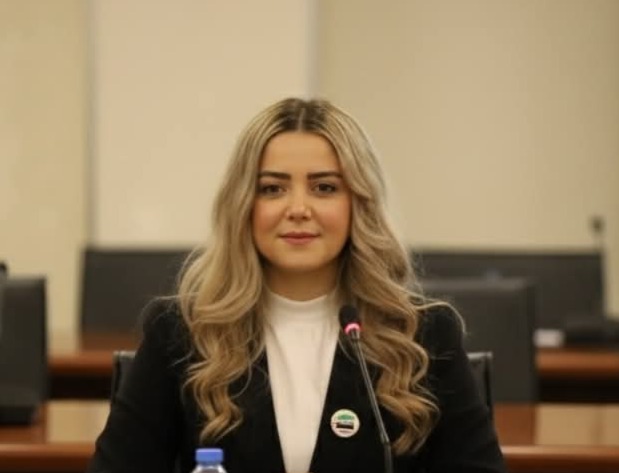
In Bab Touma on 22 March, Damascene society gathered in all its diversity. What stood out above all was the presence of women. Women organising, leading, and setting the rhythm of the street.
One woman stands among the crowd, coordinating the sit-in, thanking those present and the security forces, calmly asking people to disperse in an orderly way to avoid any pushing or chaos.
On the stage, another woman stands and says clearly, “I am Sunni,” before recounting the story of her Christian neighbour who helped her raise her children after her husband’s death.
The sit-in carried the slogan “Damascus rises”. A city long portrayed as passive now pushes back against a decision issued by its new authority.
A banner quotes Imam al-Shafi‘i, one of the four main jurists of Sunni Islam:
Perhaps a hardship tightens around a man,
Yet with God comes the way out.
It closed in, then was relieved,
And I thought it would never be.
The use of religious text in protest against a decision framed in religious terms signals an attempt to reclaim agency. The protest does not pit one group against another; it reflects a society asserting control over its own life.
Memory intervenes
For some, memory returns to Daraa in 2011, when local leaders demanded the release of children detained for graffiti and were met with humiliation by Atef Najib, then head of political security. That moment exposed the nature of the relationship between authority and society. Today, comparisons emerge. One difference stands out: in Bab Touma, security forces were present to protect the protest.
Amid the noise, I recall a line by the Syrian poet Badr al-Din al-Hamid: “I am intoxicated—between wine and the gaze”. Here, the intoxication is different: a sense of freedom shaped by years of struggle, a peaceful protest protected rather than suppressed, and the visible leadership of women.
And yet, it remains fragile. One day, even this might be deemed a violation of “public morals”.