Berlin Calling
A conversation with Clemens Hach
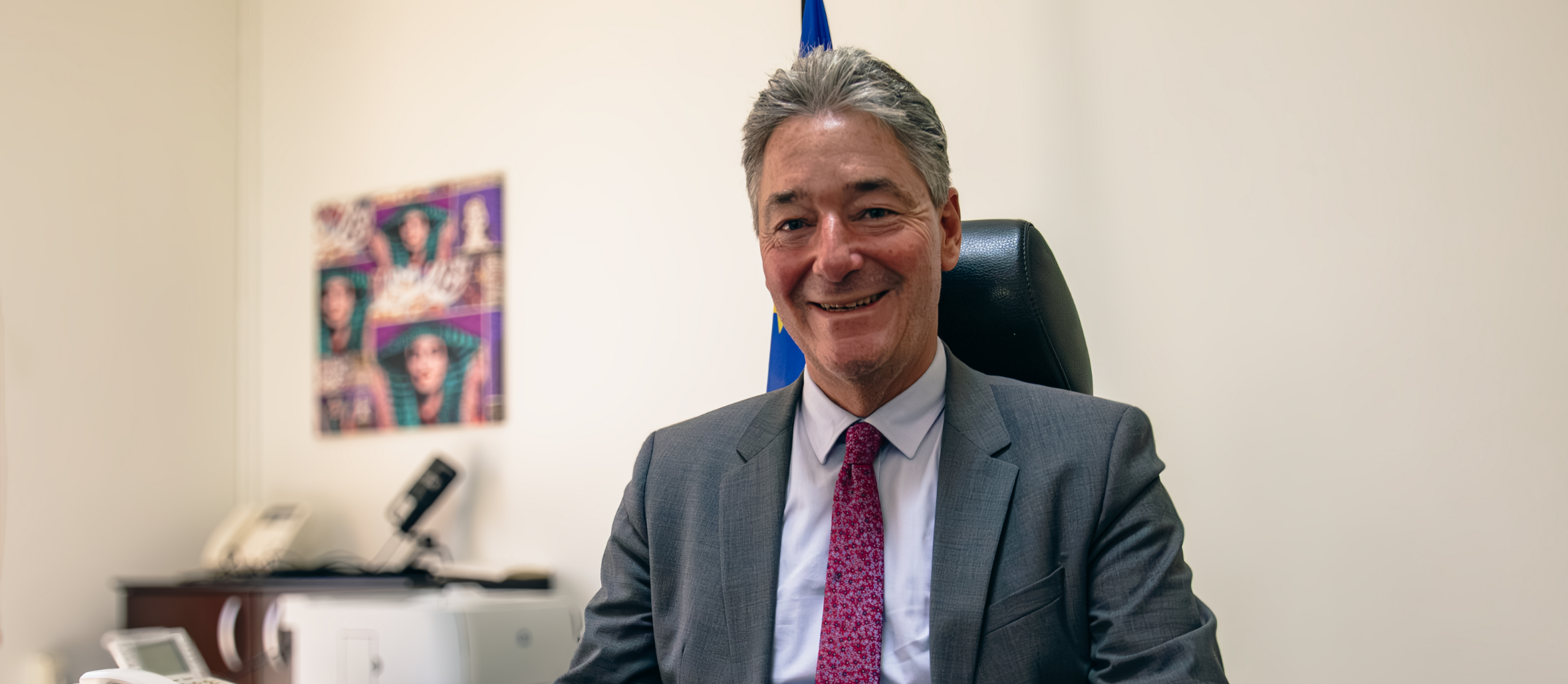
Ahmad al-Sharaa’s first stop on his European tour was Berlin. Home to the third-largest Syrian diaspora, Germany plays a central role in shaping relations between the European Union and the emerging new Syrian state. To learn more about Germany’s position on key matters such as elections, refugee returns, and aid, Syria in Transition spoke with Clemens Hach, Germany’s Chargé d’Affaires in Damascus.
Ahmad al-Sharaa just visited Berlin. What stood out to you?
Hach: President Ahmad Al Sharaa visited Berlin on Monday, 30 March, on the invitation of Federal Chancellor Friedrich Merz. This was one of the first official visits of Al Sharaa to Europe and therefore a testament to the strong bonds that have always existed between Germany and Syria and that have become even stronger thanks to the large Syrian community in Germany. He was received by Federal President Frank-Walter Steinmeier and by Chancellor Merz and participated in a large business round-table held at the Ministry of Foreign Affairs with three German and four Syrian Ministers in attendance, as well as about hundred representatives of the German business sector. He also visited the Siemens Energy factory in Berlin, to witness the production of the state-of-the-art megaturbines that shall be installed in Syria as part of Qatar’s investment in the Syrian energy sector.
The scope of the visit was to highlight the partnership between our countries, discuss our shared expectations for the future of Syria as an inclusive and free society in fulfilment of the aspirations of the Syrian people, as well as Syria’s strategic development vision as a geopolitical centrepiece in the region. Germany stands ready to support the Syrian transition as a trusted and reliable partner to Syria and its people.
The transitional government published a ‘Statement of Recovery Priorities for International Cooperation’ in March, which international partners are expected to adhere to. The document does not appear to envision continued independent needs assessments and does not differentiate between humanitarian and development mandates. Is that compatible with humanitarian principles in general and German principles in particular?
Hach: The priority of the Syrian government is recovery and reconstruction of the country, based on investment and prioritising the transition from humanitarian assistance to development cooperation. The government also wants to avoid any kind of donor dependency.
The “Recovery Priorities for International Cooperation” of the government are a mirror of the needs assessments and priorities as they have been defined over the past year since the liberation of Syria from the Assad-regime by the Government and with the support of the UN and other donors. The German cooperation priorities are aligned with these priorities, e.g. by prioritising the reconstruction of basic infrastructure, schools and the medical sector, as well as engaging in the justice sector, water governance, property rights and economic reactivation.
When it comes to humanitarian needs, we will continue to generously provide humanitarian assistance, based on independent needs assessments and humanitarian principles.
If UNSCR 2254 continues to be a legally binding resolution, does that mean that free and fair elections that the resolution stipulates are obligatory for the transitional government to realise?
Hach: The transitional declaration foresees free and fair elections in a timeframe of up to five years. For the transitional period, the Syrian government is completing a limited electoral process that is aimed at producing a representative National Assembly for the country that will fill an institutional vacuum in the legislative process. The National Assembly will play a key role as a forum for national debates and most importantly to fill the legislative vacuum that is slowing down economic recovery.
Regarding UNSCR 2254, the Syrian Government is discussing the future of this resolution with the UN and Security Council members, as well as a possible follow-up resolution that would reflect the fundamental changes that happened since 8 December, 2024 and focus on how the international community shall support the transition towards a peaceful, inclusive and prosperous Syria that lives at peace with itself and its neighbours.
Does Germany expect large-scale refugee returns from Germany to Syria in the future and is it willing to enforce them? Many Syrians, especially the 200,000-300,000 holding subsidiary protection are concerned about their future. Given that the majority of Syrians currently in Germany have been living there for quite some time and have built lives, what is the German strategy in general?
Hach: In a context where we do not see political prosecution or war in Syria anymore, many Syrians are looking forward to returning and thousands have already come back from Germany to contribute to the reconstruction of their home country. But it is clear that voluntary return is inherently linked to the availability of basic services and the restoration of infrastructure in areas of return. Germany is generously supporting the Syrian reconstruction effort and has already contributed to the return of hundreds of thousands of refugees from neighbouring countries.
You have worked on and in the region for many years in various roles. How do you make sense of where things stand today? Are we seeing the end of the Iranian regime, or the entrenchment of conflict as a permanent condition? Do you see signs of progress, or a pattern of setbacks? What are the key thoughts you find yourself returning to at the moment?
Hach: The region has indeed been going through a very difficult period since the terrorist attacks of Hamas against Israel on 7 October 2023 and the ensuing wars. Looking at the consequences, we have very positive developments in Syria. We still have a very difficult situation in Lebanon, but with a growing national consensus that Hezbollah should not continue to be allowed unilaterally to pull Lebanon into wars. And we have a terribly difficult situation in Gaza and the occupied Palestinian Territories in the West Bank. Much will depend on the outcome of the current campaign against Iran and whether the Iranian leadership will accept to refrain from foreign interference in the future and stop exporting their vision of political Islam.