Romance and reality
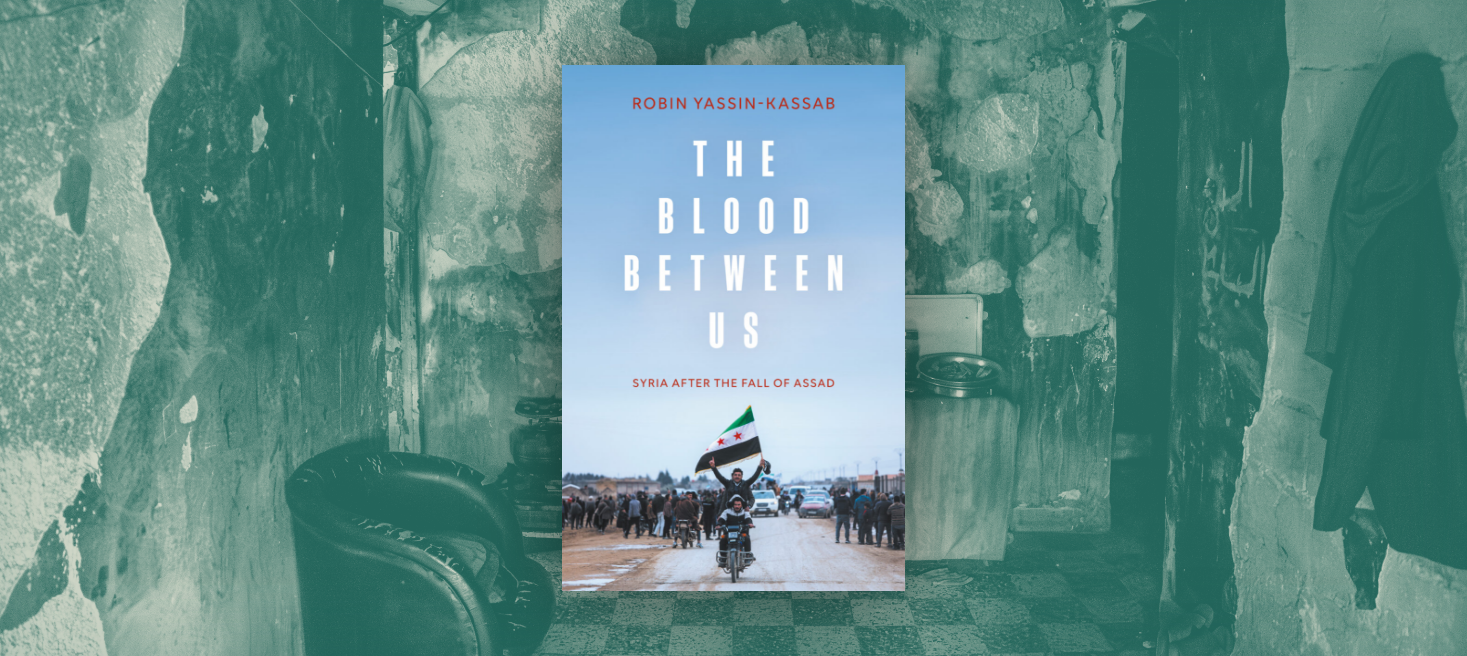
A review of Robin Yassin-Kassab’s book ‘The Blood Between Us’
In one of the first book-length attempts to grapple with Syria after Assad, Robin Yassin-Kassab chronicles the emotional experience of liberation and return after decades of dictatorship. Our review examines where understandable revolutionary romance gives way to analytical blind spots, both in the portrayal of the revolution’s genesis and in assessing authoritarian continuities.
Syria’s transition is a patchwork of unsettling and unresolved issues: provisional institutions, renewed sectarian violence, contested claims to legitimacy and the old question of whether rebel victory can become politics for all. One of the first attempts to make sense of this first year under Hay’at Tahrir al-Sham (HTS) rule is Robin Yassin-Kassab’s The Blood Between Us: Syria After the Fall of Assad, published by Saqi Books.
Yassin-Kassab is well known in English-language Syria expert and activist circles. His earlier book with Leila al-Shami, Burning Country (2016), became one of the defining English-language entry points to the revolution’s civic micro-architecture, foregrounding the Local Coordination Committees, student networks and citizen journalists. Burning Country insisted on the crucial point that before Syria became a theatre of militias and foreign patrons, there was a revolutionary civic sphere attempting self-government against a state that had monopolised politics for decades.
Authored by a writer known for sharp criticism of tyranny and oppression in Syria and the wider Middle East, Yassin-Kassab’s book arrives with a particular burden of expectation. With the Ahmad al-Sharaa government now into its second year, and showing signs of authoritarian temptations, there is no shortage of subject matter to investigate and critique.
An author at the centre of events
Before turning to the substance of Yassin-Kassab’s latest book, however, a methodological note is necessary. The author states at the outset that it is written from a personal perspective, as an involved observer who recounts the pain, anxieties and joys of the events he describes while trying to remain focused on the Syrian people as the main protagonist. Perhaps surprisingly, given his Syrian roots and his standing within the revolution’s activist sphere, he does not claim to speak as an expert, and admits that the book is “partial and radically incomplete”.
What appears humble on a personal level, however, becomes an analytical tension running through the book. The grin Yassin-Kassab describes after being warmly welcomed by a border guard when re-entering Syria is both humanly understandable and revealing of the emotional proximity that gives the narrative both its force and its blind spots. Even allowing for the political bias such writing inevitably carries, however, the analytical discipline fails to reach a level that might be expected from a writer with such knowledge and moral ambition.
The burden of doing too much
Throughout the book, the question of intention and preferred target audience repeatedly presses itself upon the reader. Across 339 pages of substantive text, the author sets himself a formidable task: to introduce inexperienced readers to the complexity of fourteen years of conflict, to illuminate the dynamics of authoritarian social formation after Assad’s fall, to reflect on the condition of the economy, and even on the environmental effects of conflict — all under a title, The Blood Between Us, that promises a deeper meditation on Syria’s burdened legacy and how it is playing out in the present transition. At times, this feels like too much ambition for a single volume. Often, the book reads like a brisk retelling of events, and at times like an extended commentary rather than a fully developed argument. This gives new observers a useful overview of how events transpired, but it also allows inaccuracies and analytical shortcuts. Some are minor, others more consequential for the book’s broader claims.
This becomes glaring in the author’s assessment of Turkey’s role in the November 2024 Deter the Aggression offensive that toppled Assad. He suggests that nobody but the revolutionaries themselves truly drove events: that the rest of the world merely reacted as Syrians finally reclaimed ownership of their own history. In many ways, this reflects an understandable longing for Syrian agency. Yet despite reporting, including by this magazine, on Turkey’s longstanding plans to expand its northern Syrian “safe zone” to include Aleppo city and its environs, Yassin-Kassab largely dismisses the possibility of behind-the-scenes coordination or longer-term strategic planning between HTS and its regional and international allies. Unconvincingly, he argues that the absence of early, full-scale mobilisation by the Syrian National Army (SNA) shows that Turkish officials, like other actors, were operating purely reactively.
Where the fog of war still hangs thick, it may be wiser to leave such matters to historians than to narrate events as though the archives were already closed.
From the romance of revolution to the trials of transition
While such inaccuracies may partly be matters of political preference in narrative writing, others cut more deeply into the book’s analytical core. This is most visible where Yassin-Kassab romanticises the attributes of the early local councils that emerged as the Assad regime’s grip on many areas receded in 2012. He describes these councils as democratic or quasi-democratic spaces where “Islamists, liberals and leftists usually worked well together”, and as bodies that “tended to be horizontally organised and meritocratic rather than ideological, councillors being elected for their practical skills.”
This is overly generous. The councils varied enormously from place to place, and the courage and commitment of many early activists were undeniable. Yet overall, local councils were not islands of horizontal self-rule. In the main they were fragile and dependent for their existence on external actors outside any democratic mandate. Armed groups supplied the muscle needed to police territory, protect logistics and enforce decisions; but that muscle also gave them leverage over welfare, security and legitimacy. Electoral experiments were rare, and mostly failures. Power would revert to the established societal pattern based on familial consensus and local notability. Activists were frequently pushed aside, even before sharia courts and Islamist factions tightened their grip on local administration.
The image of democratic self-organisation under fire is certainly appealing, but what ultimately defined the ‘liberated areas’ was compromised governance suspended between revolutionary aspiration, social hierarchy, militia power and donor-dependent financing. To say this is not to deny the emancipatory intention of early activists; it is to see how today’s failures of democratic consolidation were already incubating in yesterday’s institutions.
The regime in society
Yassin-Kassab is similarly imprecise in questioning the civil war character of the conflict and, overall, distinguishing between the Assad regime and the Syrian people without offering the deeper systemic analysis necessary to grapple with the implications of the book’s title. From a revolutionary-democratic perspective, this is understandable: it allows for a more inclusive language toward Syrians and shifts the burden of guilt onto an externalised tyrannical regime. Yet this distinction does not help in naming present conditions or in overcoming them.
As post-dictatorial reckonings elsewhere have shown, tyranny is never merely an elite project. It settles within society and works through people as much as over them. Many helped keep the regime’s institutions of violence running, including the mundane bureaucratic machinery without which repression cannot function. Others were drawn into tyrannical dynamics economically, socially or informally, at times simply to protect themselves. Some were deeply committed believers. This is not an easy truth to articulate because no one likes to confront their inner Mr. Hyde. But recognising this reality is central to allow movement beyond both victor’s narratives and competing hierarchies of victimhood. An honest account on guilt, implication and perpetration is indispensable for reconciling different segments of Syrian society, and, indeed, society as a whole, with the very idea of a state for all.
What outlives the regime
Yassin-Kassab is not blind to the authoritarian legacy that haunts Syria’s transition. In the book’s more thought-provoking chapters, he identifies dangers embedded in the new elite, its governance and its ideological origins. He also shows how deeply the logic of the violence of the Assads remains anchored in the minds of the new rulers. He traces this logic through the massacres on the coast and in Suwayda, and in early transitional justice efforts and in new forms of identity formation pointing toward Sunni Arab supremacism.
Yet Yassin-Kassab stops short of turning these observations into a systematic critique of Syrian society and the new regime. Instead, he leans toward a narrative where excessive violence is primarily the result of poor discipline among tribal irregulars and militias-turned-army units — forces that al-Sharaa, the stabilising strongman, is supposedly trying to control. What this overlooks is a substantial body of research showing how regimes enable violence without micromanaging each and every death squad. One of the central lessons of Assadist rule was precisely that calculated arbitrariness served as a tool of domination; a pattern that could also have been empirically examined in post-Assad Syria.
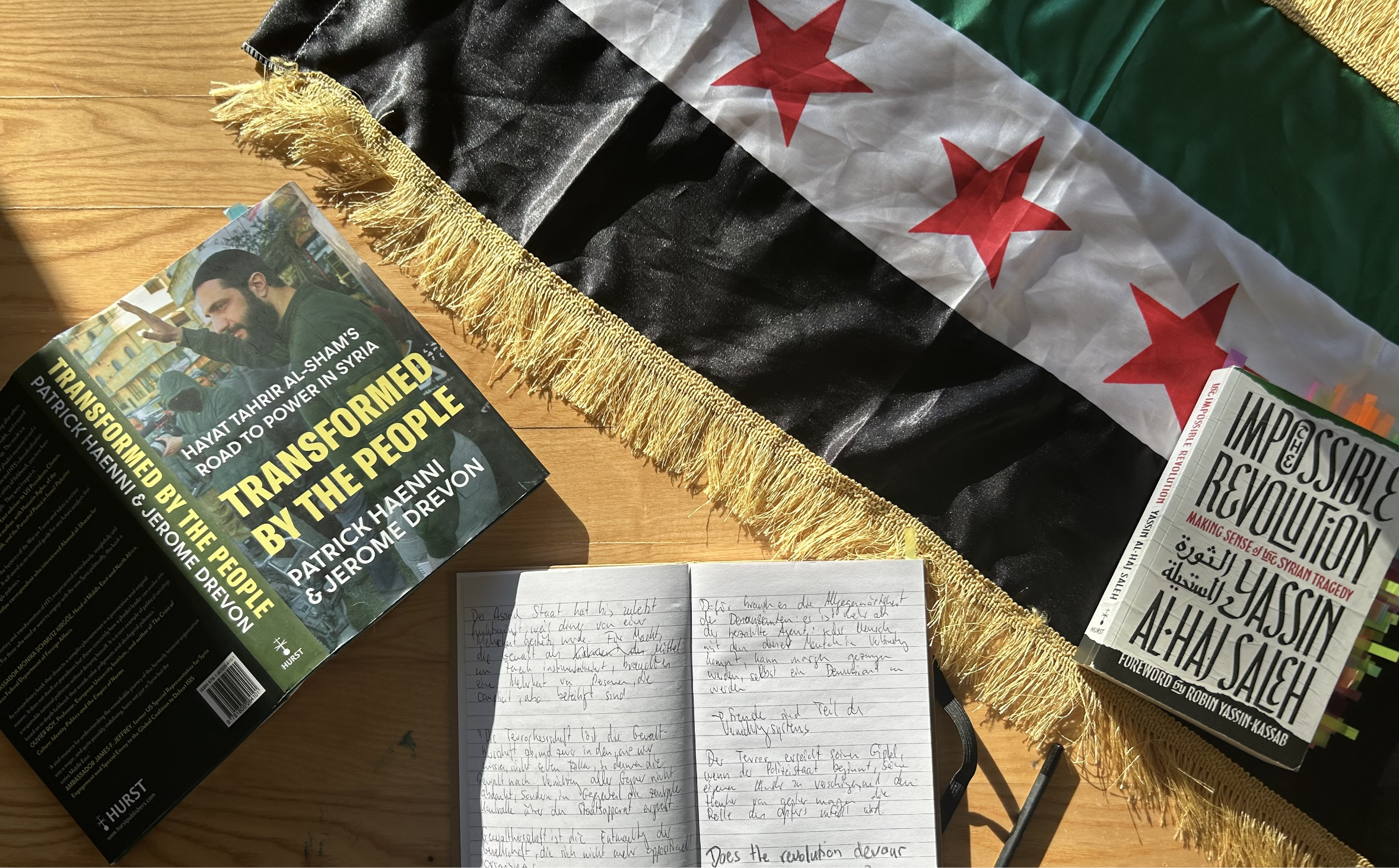
This view of a strong centre committed to pacification underpins Yassin-Kassab’s assessment of the al-Sharaa government’s broader power politics, much of which draws on the questionable analysis advanced in Transformed by the People by Jerome Drevon and Patrick Haenni, which the author references repeatedly. The argument is familiar: once HTS consolidated power in Idlib, a limited form of plurality gradually emerged. Yassin-Kassab extends this assumption to Syria as a whole, including the military campaign against the Syrian Democratic Forces (SDF) in early 2026, whose defeat and the unlikelihood of Syria becoming federal he describes as liberating the country from the “existential risk of dissolution,” while sidestepping the far broader and more nuanced debates around decentralisation that concern Syria well beyond the matter of the SDF. Once the authorities fully secure victory, Yassin-Kassab’s reasoning goes, it is hoped that breathing space will emerge for constitutional rule, pluralism and equal citizenship within a democratic order.
Beyond the victors’ peace
Ultimately, this is the logic of emergency rule – of which Syria has disastrous historical experience – and allows authoritarian continuities to take hold. It allows the new rulers to claim, again and again, that the security needed for pluralism and democracy has not yet been achieved; and it legitimises more “blood between us” on the path to achieving it.
This analytical oversight is typical of many post-Assad analyses that, in a deeply exhausted euphoria after an unexpected victory, are willing to grant an almost limitless benefit of the doubt. It reaches an irritating level when the author suggests near the end that all criticisms leveled at the Syrian authorities made in his book could be leveled at Western leaders, too.
The Blood Between Us is an ambitious attempt to document post-Assad Syria. Although appearing to have been written in haste, it offers substantial material for critical debate.